

Asia’s $1.5 Billion Fintech Mega-Rounds Reveal Widening Funding Concentration

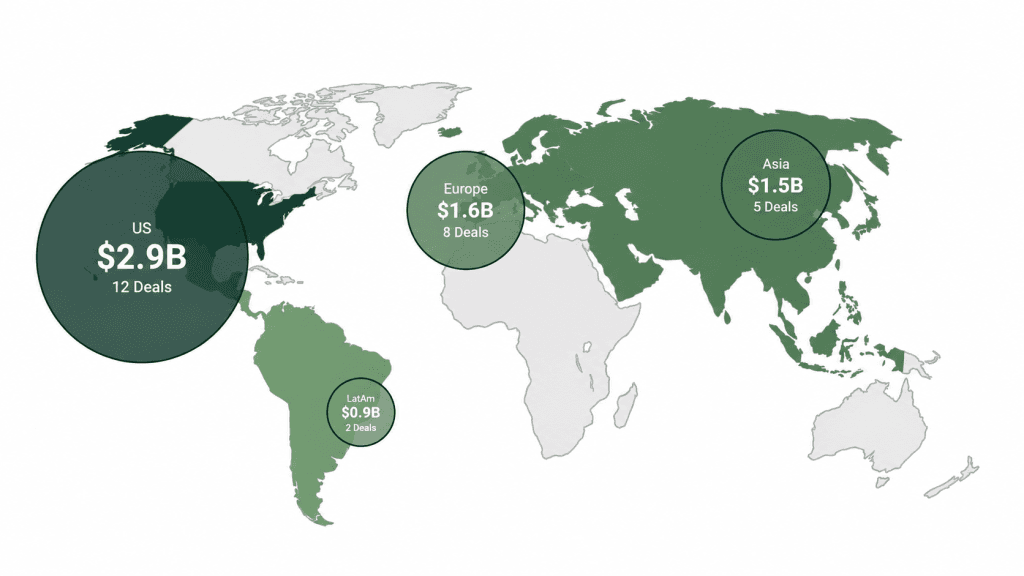
Asian fintech companies attracted $1.5 billion across five funding rounds of at least $100 million in the second quarter of 2026, trailing the United States and Europe in both capital raised and transaction volume, according to CB Insights data.
Asia accounted for approximately 22% of the $6.9 billion raised through 27 mega-rounds across four major regions. The figures reveal a financing market in which substantial capital remains available to a small number of fintech businesses, even as overall investment activity contracts. Asian Banking & Finance
US Leads Fintech Mega-Round Funding
The United States secured $2.9 billion across 12 mega-rounds, while Europe attracted $1.6 billion through eight transactions. Latin America recorded $900 million across two deals.
Asia’s total was only $100 million below Europe’s despite recording three fewer transactions.
That difference becomes clearer when measured by average deal size. Asian mega-rounds averaged approximately $300 million, compared with $200 million in Europe and $242 million in the United States.
These averages are derived from regional totals rather than the disclosed valuations or financing terms of individual companies.
The figures indicate that Asia’s lower transaction count did not translate into proportionately smaller funding commitments.
Mega-Rounds Dominate a Contracting Market
According to CB Insights’ fintech market intelligence platform, mega-rounds are financing transactions of at least $100 million.
Across the broader global fintech market, companies raised approximately $11.7 billion during the second quarter, down 20% from the preceding three months. Deal volume fell 25% to 726 transactions.
The $6.9 billion raised through mega-rounds therefore represented approximately 59% of quarterly fintech funding, even though those 27 transactions accounted for fewer than 4% of deals. Asian Banking & Finance+1
For venture capital and growth equity investors, this concentration matters because rising average deal sizes can coexist with deteriorating fundraising conditions for smaller companies.
A limited number of mature fintech platforms can absorb substantial capital while early-stage businesses face fewer financing opportunities.
Asia’s Broader Funding Picture Shows Similar Pressure
Asia’s overall fintech funding reached approximately $2.3 billion across 116 transactions in the second quarter, up from $1.7 billion in the first quarter.
However, the region represented only 19% of global fintech deal activity, unchanged from the preceding quarter.
The mega-round figures suggest that a significant portion of Asia’s quarterly funding was concentrated in five transactions.
A similar pattern appeared later in Southeast Asia.
PE NEWSWIRE’s analysis of Southeast Asia’s $2.3 billion fintech funding market found that four transactions accounted for 86% of investment during the first nine months of 2026, while the number of funding rounds declined 44%.
Although the reports cover different geographies and periods, both illustrate the importance of examining transaction counts alongside aggregate funding.
KPMG Data Confirms Uneven Regional Investment
Separate research from KPMG provides a broader perspective on fintech capital allocation.
The firm’s Pulse of Fintech H1 2026 findings showed Asia-Pacific fintech investment falling to $4.6 billion across 350 transactions, compared with $7.1 billion across 426 deals during the second half of 2025.
Globally, KPMG recorded $103.1 billion in first-half fintech investment, including venture capital, private equity and mergers and acquisitions.
These figures are not directly comparable with CB Insights’ quarterly funding totals because the reporting periods and transaction coverage differ.
Nevertheless, both datasets identify concentration among larger transactions as an important characteristic of the market. kpmg.com
Singapore has responded to weaker private investment by expanding public support for financial technology development.
PE NEWSWIRE previously examined Singapore’s S$220 million fintech innovation commitment, which targets AI adoption, financial infrastructure and commercialization.
Implications for Venture Capital Investors
The distinction between funding value and investment breadth is increasingly important for institutional investors evaluating Asian fintech exposure.
Large funding rounds may support established platforms with substantial customer bases, while declining deal activity can narrow the pipeline of younger companies available for future growth investment.
Investors assessing regional opportunities therefore need to consider financing concentration, company maturity and the availability of follow-on capital rather than relying on aggregate funding growth alone.
Asia’s second-quarter figures show that institutional-scale financing remains accessible, but its distribution across the fintech sector is highly uneven.