Europe’s Shrinking Bank Liquidity Opens New Rates Trade for Hedge Funds

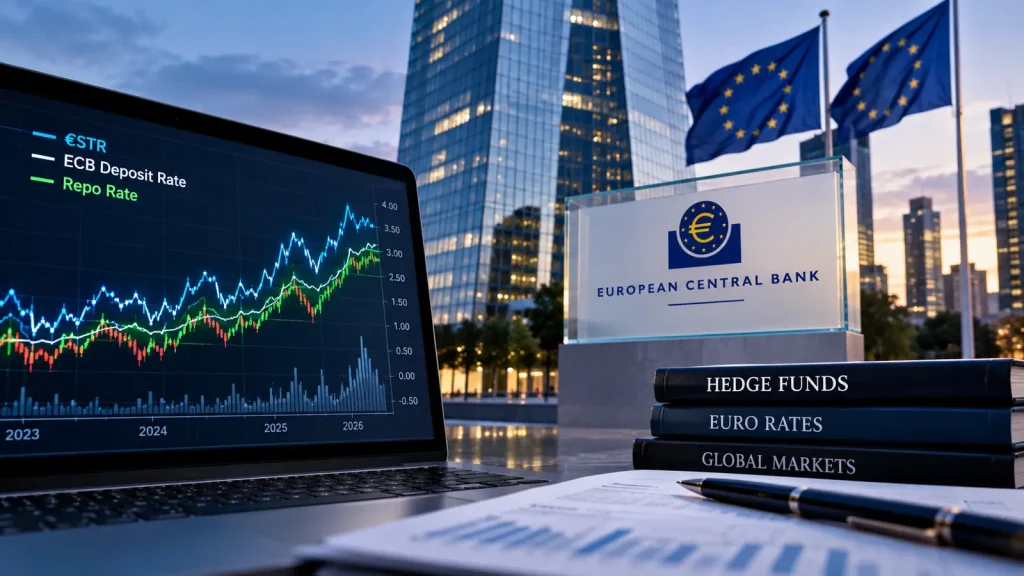
Hedge funds are increasing their focus on relative-value opportunities in European short-term interest rates as the European Central Bank’s balance-sheet runoff drains reserves from the banking system and pushes euro money-market rates closer to the central bank’s deposit rate.
Euro-area excess liquidity stood at about €2.15 trillion on Sept. 8, according to ECB data, less than half the €4.75 trillion peak reached in November 2022. The decline is changing the economics of short-term funding and creating arbitrage opportunities between unsecured borrowing, secured repo markets and instruments linked to the euro short-term rate, or €STR.
Bloomberg reported Sept. 10 that investors are piling into an arbitrage trade in euro money markets as tighter liquidity increases the prospect of further convergence between market borrowing costs and the ECB’s policy rate.
For hedge funds and bank rates desks, the opportunity is less a directional bet on where ECB policy rates are headed than a wager on how the plumbing of Europe’s financial system changes as trillions of euros of central-bank liquidity disappear.
ECB runoff has removed more than €2.5 trillion of excess liquidity
The transformation dates back to the extraordinary liquidity created during the ECB’s post-financial-crisis and pandemic asset-purchase programs.
Excess liquidity peaked at €4.748 trillion in November 2022. By Sept. 8, 2026, the ECB’s daily liquidity data showed the figure at €2.150 trillion, a reduction of roughly €2.6 trillion.
The decline is continuing as bonds purchased under the ECB’s asset purchase programme and pandemic emergency purchase programme mature without being replaced.
During the February-to-May review period alone, liquidity supplied through monetary-policy instruments fell €145 billion to €3.632 trillion. Of that decline, €144 billion resulted from the shrinking stock of APP and PEPP securities.
The ECB expects reserves to decline by approximately €470 billion annually, although the precise path remains uncertain.
That process matters for markets because excess reserves once insulated banks from having to compete aggressively for short-term cash.
With fewer reserves available, the price of liquidity becomes more important.
€STR moves closer to the ECB deposit rate
One of the clearest indicators is the relationship between €STR and the ECB’s deposit facility rate.
€STR measures the wholesale unsecured overnight borrowing costs of euro-area banks. Because some lenders contributing cash to that market do not have access to the ECB’s deposit facility, €STR has historically traded below the central bank’s deposit rate.
The spread widened when the ECB flooded the banking system with reserves.
Now it is narrowing.
During the first two reserve-maintenance periods of 2026, €STR averaged 6.8 basis points below the ECB deposit rate, compared with a seven-basis-point discount during the previous review period. Repo rates, meanwhile, averaged just 0.7 basis point above the deposit rate.
The ECB’s analysis of banks adapting to declining reserves says both unsecured and secured money-market rates have been moving closer to the deposit facility rate as reserves decline.
For relative-value investors, small changes in these spreads can become economically meaningful when positions are leveraged.
Why hedge funds care about a few basis points
The rates trade emerging from shrinking liquidity illustrates a defining feature of macro and relative-value hedge fund strategies: a price discrepancy does not need to be large if it can be financed efficiently and deployed at scale.
Investors can construct positions around differences among €STR-linked instruments, repo funding and expectations for the ECB deposit rate, seeking to capture convergence as reserve scarcity increases.
The underlying thesis is that continued quantitative tightening will make reserves incrementally more valuable.
Banks approaching their preferred reserve levels should become more active borrowers in money markets or through ECB refinancing facilities. Greater competition for cash can then push short-term market rates closer to — and under some conditions potentially above — the rate paid by the ECB.
The ECB estimates that by the end of 2026, banks representing about half of euro-area banking assets could be close to their preferred reserve levels.
That does not mean Europe is approaching a liquidity crisis. Aggregate reserves remain abundant, and euro-area banks maintain substantial liquidity buffers.
Instead, the change is creating more price differentiation in markets that spent years operating with exceptionally abundant central-bank cash.
Hedge funds already carry significant leverage
The opportunity comes with a risk that is increasingly attracting regulatory attention.
Relative-value strategies typically seek to monetize small pricing discrepancies. To make those discrepancies produce meaningful returns, funds can use substantial leverage.
The ECB said in its May Financial Stability Review that relative-value hedge funds active in European sovereign bonds have leverage ratios of about 25 times. The central bank warned that leveraged positions could require rapid unwinding if bond prices move sharply, potentially magnifying market volatility.
The finding matters because the same funding markets producing new opportunities can also become transmission channels during periods of stress.
A sudden movement in interest rates or collateral values can generate margin calls. Funds may then need to reduce positions quickly, turning an arbitrage strategy designed around small price discrepancies into a source of procyclical selling.
The ECB’s May 2026 Financial Stability Review said the largest hedge funds continue to operate with leverage significantly above the industry average and highlighted their growing activity in European sovereign bond markets.
Hedge funds become more important to European bond markets
The money-market trade is part of a broader increase in hedge fund activity across European fixed income.
PE NEWSWIRE has tracked that trend through Capula’s launch of a $3 billion quantitative fund, as large alternative managers continue raising capital for systematic and macro strategies capable of exploiting dislocations across rates, currencies and derivatives.
The ECB has separately identified global hedge funds as increasingly important participants in euro-area sovereign debt.
That involvement can improve liquidity during normal markets because funds add buyers, sellers and arbitrage capital. But leveraged investors can behave differently from traditional pension funds, insurers and banks when volatility rises.
The ECB has warned that hedge funds’ price-sensitive strategies could amplify moves if multiple managers attempt to unwind similar positions simultaneously.
That risk is particularly relevant as governments issue more bonds while the ECB is no longer absorbing supply through quantitative easing.
New derivatives make ECB rates easier to isolate
European exchanges are also developing instruments specifically designed for the changing rates environment.
Eurex launched ECB-Dated €STR Futures in December 2025, giving investors exposure to individual ECB policy meetings rather than requiring them to trade contracts spanning several rate decisions.
The contracts follow the ECB’s reserve-maintenance periods, allowing macro hedge funds, bank trading desks and asset managers to isolate changes in short-term rates around a single policy decision.
That creates another tool for expressing views on both monetary policy and liquidity.
For example, an investor can distinguish between expectations that the ECB will change its deposit rate and expectations that €STR will move relative to that rate as bank reserves decline.
That separation is increasingly relevant as quantitative tightening affects market rates independently of changes in the ECB’s headline policy stance.
Balance-sheet normalization becomes a hedge fund catalyst
The changing European rates environment also fits a wider pattern in which central-bank balance-sheet policy is becoming a more important source of market opportunities.
PE NEWSWIRE recently examined how global bond yields surged as financing conditions tightened across private markets. The euro money-market trade operates at the opposite end of the yield curve, but both developments show how changes in rates and liquidity are feeding directly into alternative-investment strategies.
The key variable for hedge funds is not simply how much excess liquidity remains.
It is when individual banks begin behaving as if reserves are scarce.
The ECB has emphasized that reserves are unevenly distributed. Some institutions will therefore reach their preferred minimum liquidity levels before the banking system as a whole appears short of cash.
That creates the potential for funding spreads to move before aggregate liquidity reaches a clearly defined scarcity threshold.
The opportunity grows as the cushion shrinks
Europe’s banking system is still far from the funding stress experienced during past financial crises. Banks remain well capitalized, liquidity ratios are high and the ECB continues offering refinancing operations against broad collateral.
But the direction of travel is clear.
More than €2.5 trillion of excess liquidity has disappeared since late 2022, and the ECB expects reserves to continue declining as its securities portfolios mature.
That changes the incentives facing banks, hedge funds and other money-market participants.
When reserves were close to €5 trillion, differences of a few basis points across short-term funding markets could remain compressed or economically unimportant. At roughly €2.15 trillion and falling, banks must increasingly decide whether to hold reserves, lend them, borrow them or substitute other liquid assets.
Hedge funds are positioning around those decisions.
The trade therefore provides an early indication of how Europe’s financial markets may behave as the ECB moves from a system defined by extraordinary liquidity toward one in which the price of reserves matters again.
For alternative investors, that transition creates opportunity. For regulators, the question is whether increasingly leveraged arbitrage capital can absorb the adjustment smoothly — or whether the same positions that improve market efficiency in normal conditions become a source of volatility when liquidity tightens abruptly.