

Global Regulators Propose New Toolkit to Tackle Cyber Risks in Financial Market Infrastructures

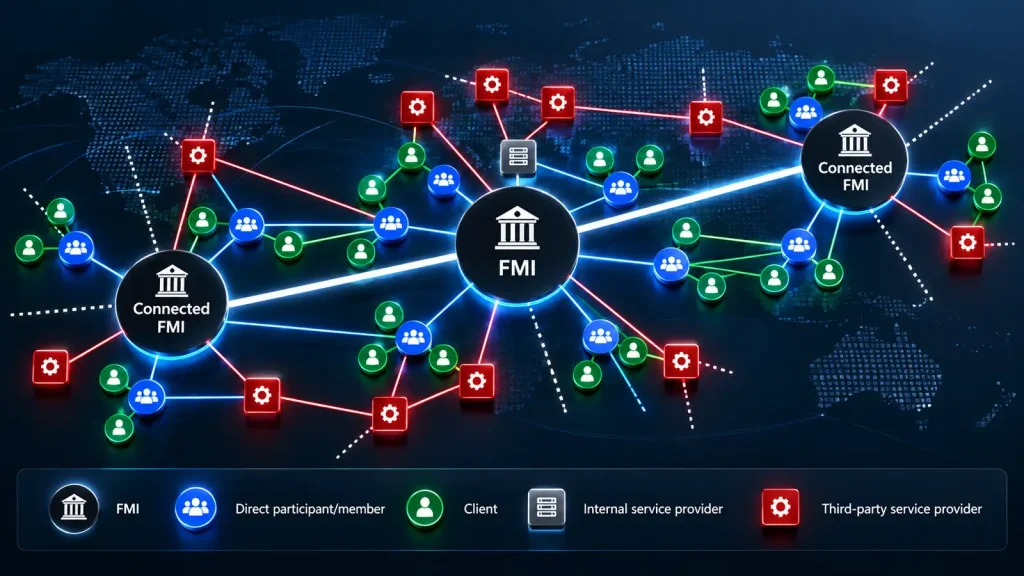
Global standard setters have proposed a new cyber resilience toolkit for financial market infrastructures as regulators increase scrutiny of the technology vendors supporting payment systems, central counterparties, securities depositories and other critical nodes of the financial system.
The Committee on Payments and Market Infrastructures, hosted by the Bank for International Settlements, and the International Organization of Securities Commissions published the consultative toolkit Sept. 8 alongside a separate discussion paper on third-party service providers. The proposals are voluntary and non-binding, but they provide a more detailed framework for applying existing international standards to an increasingly interconnected technology environment.
For private-market investors, the consultation is relevant beyond regulated financial infrastructure. Payment technology, clearing, cybersecurity, cloud services and other financial software have attracted private equity and venture capital, while the regulatory emphasis on vendor dependencies increases the importance of operational resilience during technology due diligence.
Cyber toolkit builds on decade-old framework
The CPMI-IOSCO cyber resilience toolkit is intended to help financial market infrastructures implement the operational-resilience components of the Principles for Financial Market Infrastructures, or PFMI.
It supplements rather than replaces cyber guidance issued by CPMI and IOSCO in 2016. That earlier framework focused on five risk-management categories — governance, identification, protection, detection, and response and recovery — supported by testing, situational awareness, and continuous learning.
The new toolkit translates those principles into more practical considerations across areas such as governance, cyber-risk identification, protective controls, detection, response, recovery and testing.
The distinction matters because the financial system has changed substantially since the original guidance was published. Cloud computing, software-as-a-service platforms and increasingly concentrated technology supply chains mean critical infrastructure operators can depend on external companies for functions that were historically maintained internally.
The standard setters are seeking industry comments through Dec. 1, 2026.
Third-party providers become systemic resilience issue
The companion consultation addresses that dependency directly.
The CPMI-IOSCO discussion paper on third-party service providers examines risks created when financial market infrastructures rely on outside companies to deliver critical services.
The paper does not establish new regulatory requirements. Instead, CPMI and IOSCO are seeking feedback on the challenges surrounding third-party services and whether further international work is required.
That question has implications for cloud infrastructure, cybersecurity vendors, data providers and other technology companies servicing multiple financial institutions.
A payment system or clearinghouse can strengthen its own cybersecurity controls while remaining exposed to an outage or compromise at a critical vendor. Concentration can deepen that risk if multiple financial institutions depend on the same provider.
The issue therefore moves cybersecurity analysis from individual companies toward entire technology supply chains.
FMIs sit at the center of market plumbing
Financial market infrastructures occupy an unusual position because they do not simply provide financial services to individual customers.
They underpin payments, securities settlement, clearing and other processes through which financial transactions are completed. Disruption at a sufficiently important FMI can therefore transmit operational problems to banks, asset managers, brokers and investors that were not directly targeted by a cyberattack.
The 2016 CPMI-IOSCO guidance emphasized this interconnectedness, describing cyber resilience as a collective challenge involving FMIs, their participants and other stakeholders.
That interconnected role also explains why recovery speed is a central regulatory concern.
A 2022 CPMI-IOSCO assessment found generally high adoption of the earlier cyber guidance but identified a serious concern involving a small number of FMIs that had not fully developed response and recovery plans capable of meeting the framework’s two-hour recovery objective for critical information technology systems.
The assessment also found shortcomings in scenario testing, testing following major system changes and the involvement of participants and critical service providers in exercises.
The new toolkit gives operators a more practical framework for addressing those weaknesses without replacing the underlying PFMI standards.
Private capital exposure extends beyond regulated operators
For alternative investment managers, the regulatory development matters because private capital increasingly owns or finances companies embedded in financial-market technology.
Cybersecurity is consequently becoming both an investment opportunity and a portfolio governance issue.
PE NEWSWIRE previously examined Bain Capital’s exposure to litigation following the PowerSchool data breach, where a federal court allowed several claims against the private equity owner to proceed. No liability has been determined, but the litigation illustrates how operational cybersecurity questions can extend beyond a portfolio company toward its sponsor when ownership and operational control are disputed.
Financial infrastructure can present an even more complex risk profile because outages can affect numerous counterparties simultaneously.
For private equity buyers assessing payment processors, market infrastructure software or other mission-critical financial technology, vendor mapping therefore becomes relevant alongside traditional cybersecurity due diligence.
Investors may need to determine not only whether a company protects its own systems but also which cloud providers, software vendors and data services support essential functions, how substitutable those providers are and what recovery options exist if a vendor fails.
Cybersecurity spending creates an investment opportunity
The regulatory push also supports demand for technology capable of monitoring and mitigating cyber risk.
Financial institutions need threat intelligence, penetration testing, identity security, incident response, third-party risk monitoring and other tools to meet increasingly demanding resilience expectations.
That has helped cybersecurity remain one of the more durable areas of technology investment. PE NEWSWIRE reported that cybersecurity venture investment held near $5 billion in the first quarter of 2026 even as financing became increasingly concentrated among larger transactions and AI-focused companies.
Regulatory attention to financial infrastructure could expand the addressable market for vendors capable of serving institutions with particularly stringent resilience requirements.
The opportunity is not limited to cybersecurity software. Companies offering infrastructure observability, operational resilience testing, third-party risk analytics and business-continuity technology can also benefit as financial institutions seek greater visibility into technology dependencies.
Concentration risk becomes the next regulatory question
The third-party discussion paper may ultimately prove as consequential as the cyber toolkit itself.
A financial institution can impose controls on its vendors, negotiate contractual protections and establish recovery plans. Those measures become less effective, however, when a service is difficult to replace or when the same vendor supports many critical institutions.
That creates a potential concentration problem.
The BIS lists management of third-party and outsourcing risks among CPMI’s priorities for strengthening the financial and operational resilience of FMIs. IOSCO’s 2026 work program similarly identified third-party dependencies and cyber resilience as areas for continued joint work with CPMI.
The consultations stop short of proposing direct regulation of major technology providers. Instead, they seek industry evidence about where vulnerabilities exist and whether current risk-management practices are sufficient.
That makes the Dec. 1 consultation deadline important for infrastructure operators and their vendors. Industry responses could influence whether international standard setters eventually move from practical guidance toward more formal expectations around outsourcing and technology concentration.
For private capital, the direction is already relevant. Financial technology assets serving mission-critical institutions increasingly need to be evaluated not only for recurring revenue and customer retention, but also for whether their operational architecture can withstand the regulatory scrutiny that comes with becoming part of the financial system’s core infrastructure.