

Nvidia, Micron Set to Drive 34% of S&P 500 Earnings Growth in Q3 2026

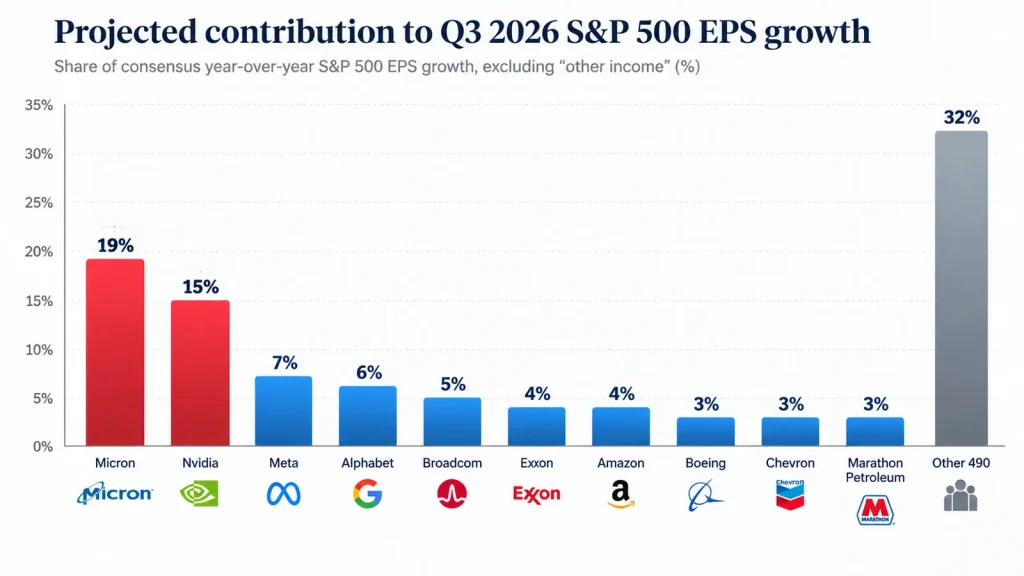
Nvidia and Micron Technology are projected to generate a combined 34% of the S&P 500’s third-quarter 2026 earnings-per-share growth, according to Goldman Sachs and FactSet estimates, illustrating how heavily U.S. corporate profit expansion has become concentrated in companies supplying artificial intelligence infrastructure.
The two semiconductor manufacturers are expected to contribute more to the index’s aggregate earnings growth than the bottom 490 S&P 500 companies combined. The forecast reflects the rapid expansion of AI computing infrastructure and the demand for advanced memory used alongside powerful processors.
Crucially, the 34% figure represents the companies’ contribution to expected EPS growth, not their share of total S&P 500 earnings. It measures how much Nvidia and Micron are expected to contribute to the increase in index profits, rather than how much of the index’s total profit pool they earn.
That distinction matters for institutional investors assessing whether the broader equity market’s earnings outlook is supported by diversified corporate growth or increasingly dependent on a narrow group of technology suppliers.
Two chipmakers account for one-third of expected profit growth
The Goldman Sachs and FactSet breakdown assigns 19% of expected S&P 500 EPS growth to Micron and another 15% to Nvidia.
The next-largest contributors are Meta Platforms at 7%, Alphabet at 6% and Broadcom at 5%. Exxon Mobil and Amazon each contribute 4%, while Boeing, Chevron and Marathon Petroleum each account for approximately 3%.
Together, the 10 companies are projected to generate about 68% of index earnings growth, leaving the other 490 constituents responsible for approximately 32%.
The estimates are striking because the earnings contributions are much more concentrated than the number of companies involved.
Micron’s projected contribution is particularly notable. Although Nvidia has become the most visible public-market beneficiary of the AI infrastructure boom, Micron’s expected share of incremental index earnings exceeds Nvidia’s in the Goldman Sachs breakdown.
The figures are forecasts for the third quarter, not reported earnings results. Actual contributions could change as companies release results and analysts revise estimates.
Micron’s memory profits explain its outsized contribution
Micron’s position at the top of the earnings-growth ranking reflects the economics of AI memory rather than simply its market capitalization.
AI accelerators require high-bandwidth memory, or HBM, to move large quantities of data quickly between memory and processors. As AI models become larger and more computationally demanding, memory capacity and bandwidth have become increasingly important components of data-center performance.
Micron’s financial results provide evidence of that demand.
The company reported $54.23 billion in revenue for its fiscal fourth quarter ended Sept. 3, 2026, compared with $11.32 billion a year earlier. GAAP net income increased to $37.70 billion from $3.20 billion, according to Micron’s official fiscal 2026 results.
Micron’s fiscal reporting periods do not exactly match the calendar-quarter framework used in the S&P 500 contribution analysis. Its results nevertheless demonstrate the magnitude of the semiconductor earnings expansion underlying analysts’ expectations.
The company has also pursued strategic customer agreements intended to improve demand visibility and support investments in manufacturing capacity.
For investors, Micron’s performance raises an important question: how much of the current profitability reflects sustainable structural demand, and how much depends on exceptionally tight memory supply and favorable pricing?
A future increase in industry production capacity could change that balance even if AI computing demand continues to expand.
Nvidia remains central to AI infrastructure spending
Nvidia’s projected 15% contribution reflects its position in the supply chain for accelerated computing.
The company’s graphics processing units, networking equipment and supporting software form a central part of the infrastructure used to train and operate advanced AI systems.
That position gives Nvidia direct exposure to spending by hyperscale cloud providers, AI developers and enterprises building computing capacity.
However, the Goldman Sachs analysis illustrates that Nvidia is no longer the only semiconductor company capturing an unusually large share of incremental profits.
Micron’s projected contribution exceeds Nvidia’s, while Broadcom adds another 5% of expected index earnings growth.
Combined, these three semiconductor companies account for approximately 39% of projected S&P 500 EPS growth in the supplied breakdown.
That concentration connects equity-market earnings expectations to the capital spending decisions of a relatively small group of major technology companies.
It also has implications for private markets. AI data centers require land, electricity, cooling systems, specialized equipment and financing structures that can involve infrastructure equity, private credit and institutional co-investment.
PE NEWSWIRE previously examined this financing model in its coverage of the Broadcom, Apollo and Blackstone $35 billion AI infrastructure platform.
The connection is increasingly direct: infrastructure investment supports demand for semiconductor equipment, which in turn supports earnings growth at suppliers such as Nvidia and Micron.
Why the other 490 companies matter
The most consequential finding in the Goldman Sachs and FactSet chart is not simply that Nvidia and Micron contribute 34% of expected earnings growth. It is that the remaining 490 companies collectively contribute less than those two chipmakers.
This suggests that a strong headline earnings-growth figure can conceal considerable differences in performance across the index.
The 490-company group is not necessarily unprofitable. Many of its members may be generating substantial earnings, while others experience slower growth or declining profits.
The chart measures contributions to the change in index EPS, not the absolute amount of profits generated by each company.
That distinction is essential. A mature business with stable multibillion-dollar profits may contribute relatively little to incremental earnings growth, while a semiconductor company experiencing an extraordinary earnings expansion can contribute disproportionately.
The concentration also complicates comparisons between capitalization-weighted and equal-weighted equity strategies. Investors holding the standard S&P 500 receive substantially different exposure to large technology companies than investors allocating equally across constituents.
What could challenge the AI earnings boom?
The Goldman Sachs figures identify a source of market strength, but they also reveal several risks.
First, earnings expectations depend on continued investment in AI infrastructure. If major cloud providers reduce capital expenditure or delay projects, semiconductor order growth could moderate.
Second, the memory industry remains exposed to supply cycles. Micron’s exceptional profitability could face pressure if production capacity catches up with demand or pricing conditions normalize.
Third, higher interest rates can reduce the valuations investors are willing to pay for future earnings, even when companies continue reporting strong operating results.
The relationship between AI spending and investment returns is also becoming more important for infrastructure investors.
PE NEWSWIRE has examined how Blackstone and Brookfield are repositioning AI data-center investments through asset sales, financing transactions and capital recycling.
For investors financing data centers, the critical question is whether demand and contracted cash flows can support the cost of construction, power infrastructure and computing equipment.
For public-equity investors, the related question is whether chipmakers can sustain their current rates of profit growth once the initial infrastructure expansion becomes a more mature investment cycle.
Earnings season will test the concentration thesis
The third-quarter reporting season will provide an important test of the forecasts.
The Goldman Sachs and FactSet estimates suggest that AI-related semiconductor companies are expected to account for a disproportionately large share of S&P 500 earnings growth, even as the broader index contains businesses spanning financial services, health care, consumer goods, industrials and energy.
There is also a difference between strong aggregate earnings and broad earnings participation. The index can produce impressive overall profit growth while many individual companies deliver comparatively modest improvements.
That matters for institutional asset allocation, portfolio diversification and assessments of equity-market valuations.
The concentration does not establish that U.S. equities are overvalued or that the AI investment cycle is unsustainable. It does show how sensitive the index’s expected profit expansion has become to a small number of semiconductor suppliers.
The central finding is unusually stark: Nvidia and Micron are projected to generate more than one-third of the S&P 500’s third-quarter EPS growth, exceeding the combined contribution of the bottom 490 companies.
For investors, the next question is whether AI-driven profitability can broaden beyond its leading suppliers — or whether the U.S. market’s earnings growth will continue to depend disproportionately on the companies supplying the chips and memory behind the AI infrastructure boom.