
Blackstone and Canadian Pension Funds Commit $3.1 Billion to LNG Canada Investment

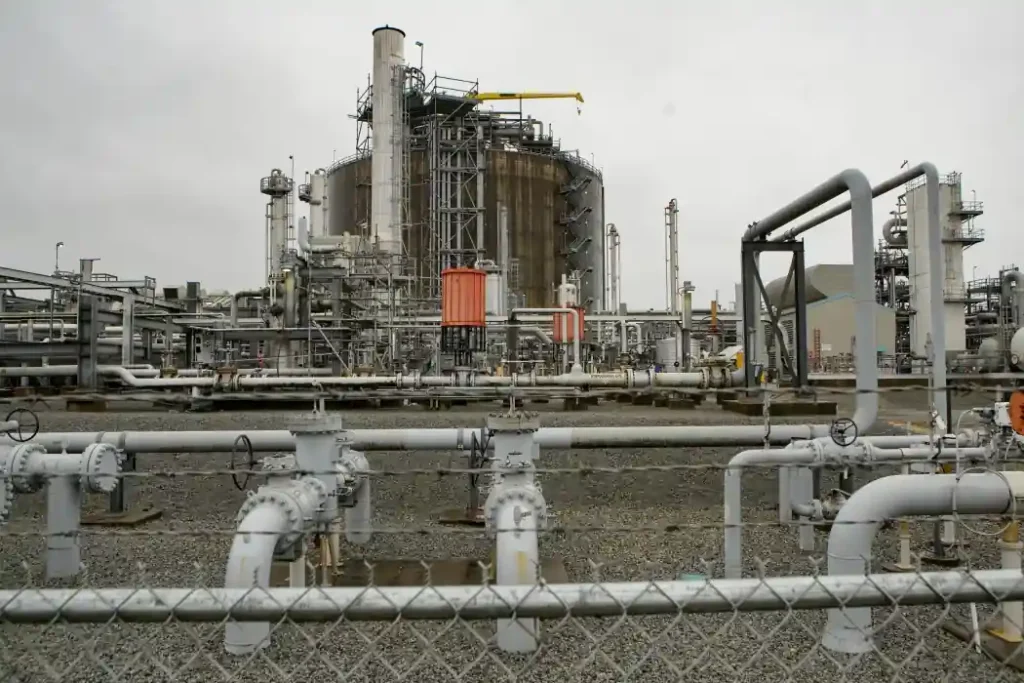
Blackstone Credit & Insurance and four major Canadian institutional investors have agreed to invest $3.1 billion in a Mitsubishi Corp. subsidiary holding an interest in LNG Canada, giving private capital investors exposure to one of North America’s largest liquefied natural gas infrastructure developments.
Announced Nov. 2, 2026, the agreement involves acquiring a 49.9% noncontrolling interest in a Mitsubishi holding company that owns 15% of LNG Canada, the Shell-led export facility in Kitimat, British Columbia. The investment comes weeks after project partners approved a major expansion that will double the terminal’s annual production capacity to 28 million metric tons.
The transaction provides Mitsubishi with additional capital for its Canadian LNG operations while allowing the Japanese conglomerate to maintain control of its investment and preserve its commercial LNG supply arrangements.
Canadian Pension Funds Join Blackstone-Led Consortium
The investor consortium includes funds managed by Blackstone Credit & Insurance alongside four Canadian institutional investors: Canada Pension Plan Investment Board (CPP Investments), Ontario Municipal Employees Retirement System (OMERS), Investment Management Corp. of Ontario (IMCO) and Public Sector Pension Investment Board (PSP Investments).
According to the Blackstone transaction announcement, the consortium will acquire its interest through Mitsubishi’s existing subsidiary rather than directly purchasing shares in the LNG Canada joint venture.
The distinction matters for investors assessing ownership rights and commercial exposure. Mitsubishi will remain the controlling shareholder of the holding company, while the incoming investors gain an economic interest in the liquefaction infrastructure business.
Mitsubishi separately valued the 49.9% holding-company interest at approximately $1.6 billion. The broader $3.1 billion investment commitment also supports the project’s expansion, meaning the total commitment should not be interpreted solely as the purchase price for the existing stake.
The companies did not disclose individual investment commitments, expected returns or the detailed capital structure of the consortium’s participation.
LNG Canada Expansion Creates Long-Term Infrastructure Opportunity
LNG Canada began production in June 2025 and is currently Canada’s only operating large-scale LNG export terminal.
Its ownership consortium comprises Shell, which holds 40%, Malaysia’s Petronas with 25%, PetroChina with 15%, Mitsubishi with 15% and Korea Gas Corp. with 5%.
The existing facility has annual production capacity of approximately 14 million metric tons. Following a final investment decision in September 2026, the partners are proceeding with Phase 2, which will add two liquefaction trains and increase total capacity to 28 million metric tons annually.
The expansion also includes additional storage, loading and supporting infrastructure, along with increased transportation capacity on the Coastal GasLink pipeline.
Mitsubishi currently receives approximately 2.1 million metric tons of LNG annually through its project interest. That volume is expected to increase to 4.2 million metric tons once the expansion becomes operational in the early 2030s.
The Japanese company markets its LNG primarily to Asian customers, including buyers in Japan, through its Singapore-based subsidiary Diamond Global Energy.
Mitsubishi’s November transaction announcement confirms that the new financial partnership will not alter its LNG offtake volumes or existing customer relationships.
For institutional investors, the arrangement provides participation in an established operating asset alongside exposure to additional capacity under development. However, the expansion also introduces construction, execution and future commodity-market risks that must be evaluated separately from the operating facility’s existing performance.
Blackstone Expands Corporate Infrastructure Financing Strategy
The investment fits within Blackstone’s broader strategy of providing structured capital to corporations seeking to finance major assets without relinquishing full operational control.
Blackstone’s Infrastructure and Asset Based Credit platform manages approximately $140 billion and has participated in several large corporate financing transactions involving energy infrastructure and Canadian businesses.
Recent announced commitments include a $7 billion investment in Sempra Infrastructure Partners’ Port Arthur LNG Phase 2 development, a $5.34 billion joint venture with Williams and a $3.5 billion joint venture with EQT.
Blackstone has also announced multibillion-dollar transactions involving Rogers Communications and Aeroplan in Canada.
These investments illustrate how private credit and asset-based financing platforms are moving beyond conventional corporate lending into structured ownership and financing arrangements involving infrastructure assets.
Unlike a traditional buyout, the Mitsubishi transaction allows the original corporate owner to preserve strategic control while bringing in outside institutional capital.
For Mitsubishi, that structure creates an opportunity to improve capital efficiency while retaining its position across Canadian natural gas production, liquefaction and LNG marketing.
For Blackstone and its institutional partners, the investment provides exposure to infrastructure supporting long-term energy exports, although the precise distribution of investment risks and returns has not been publicly detailed. Blackstone
Why the Transaction Matters for Institutional Investors
The participation of CPP Investments, OMERS, IMCO and PSP Investments demonstrates the scale of Canadian pension capital being deployed alongside global alternative-asset managers.
The investment combines several characteristics relevant to long-duration institutional portfolios: exposure to a major domestic infrastructure asset, participation in international energy trade and an established corporate partner responsible for commercial operations.
LNG Canada’s Pacific Coast location provides relatively direct shipping access to Asian markets, avoiding several major maritime chokepoints associated with other LNG supply routes.
Its expansion will also use existing infrastructure, including the Coastal GasLink transportation corridor, although additional compression and processing capacity will be required.
The transaction nevertheless carries important considerations for pension investors. LNG infrastructure returns can depend on project financing arrangements, construction performance, operating costs and the commercial terms governing LNG production and delivery.
Long-term demand assumptions and climate-related transition risks are also relevant, particularly for investors whose liabilities extend over several decades.
The participation of pension funds therefore represents a significant allocation to energy infrastructure, not an indication that the investment is free from commodity, regulatory or transition risk.
A Financing Model for Capital-Intensive Energy Projects
The Mitsubishi agreement provides a further example of how major corporations can attract private institutional capital into established infrastructure subsidiaries while preserving operational and commercial relationships.
For capital-intensive LNG developments, this approach can help distribute funding requirements among corporate sponsors, alternative-asset managers and long-term institutional investors.
The transaction also illustrates the increasingly important distinction between corporate ownership, infrastructure financing and commercial control in private-market investment structures.
Goldman Sachs acted as lead structuring agent and financial adviser to Blackstone, with Scotiabank also providing financial advice. Kirkland & Ellis and Stikeman Elliott served as Blackstone’s legal advisers, while RBC Capital Markets was Mitsubishi’s exclusive financial adviser.
The immediate investment case centers on an operating LNG facility and a sanctioned expansion project. Its longer-term outcome will depend on construction delivery, financing economics and the competitiveness of Canadian LNG exports in Asian energy markets