
Private Equity Leaders Back Continuation Funds as Investor Scrutiny Intensifies


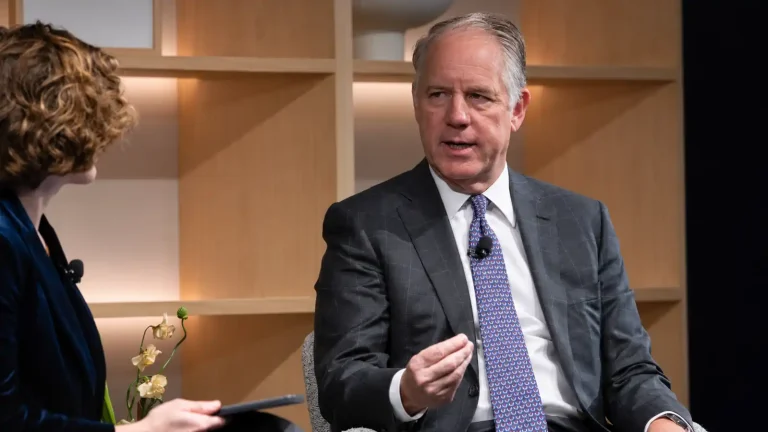
Senior executives from Leonard Green & Partners, Hamilton Lane, Carlyle Group and Bain Capital defended private equity’s evolving investment model at a Hong Kong financial summit as institutional investors intensified scrutiny of continuation funds, valuation practices and conflicts of interest in manager-led secondary transactions.
The debate comes as continuation vehicles become a more established route for generating liquidity from private equity portfolios. The Institutional Limited Partners Association (ILPA) estimates that these structures now account for approximately 14% of sponsor-backed exits globally, raising questions about how managers balance extended asset ownership with investors’ demands for distributions.
Leonard Green and Hamilton Lane Defend Continuation Funds
Jonathan Sokoloff, managing partner at Leonard Green & Partners, acknowledged opposition among limited partners but argued that continuation funds have become a permanent feature of the private equity market.
Speaking at the Hong Kong summit, Sokoloff said the structures would continue despite criticism from institutional investors.
Hamilton Lane co-CEO Juan Delgado-Moreira also defended continuation vehicles, emphasizing their ability to accommodate investors with different liquidity requirements.
Under a typical continuation fund transaction, a private equity sponsor transfers one or more portfolio companies from an existing fund into a newly established investment vehicle.
Existing limited partners can generally receive cash proceeds or reinvest their interests in the new structure. Incoming secondary investors provide capital, while the original sponsor continues managing the underlying assets.
Delgado-Moreira pointed to historical performance figures indicating that assets transferred into continuation vehicles had generated average investment multiples of approximately four times invested capital.
Those figures, presented during the summit, should not be interpreted as independently verified returns for the broader continuation fund market. Performance comparisons depend on transaction selection, measurement periods and whether reported returns represent realized proceeds or unrealized valuations.
Continuation Funds Become a Major Private Equity Exit Channel
The industry’s growing reliance on continuation vehicles reflects a prolonged challenge in traditional private equity exits.
Higher financing costs, uncertain valuations and constrained initial public offering activity have complicated portfolio-company sales, leaving managers holding investments beyond their originally anticipated exit periods.
Continuation funds offer an alternative to selling businesses outright, allowing sponsors to maintain ownership while providing liquidity to investors seeking distributions.
The growth is visible in transaction activity. GP-led secondary transactions reached approximately $65 billion globally during the first half of 2026, up 35% from the corresponding period in 2025, according to Evercore figures cited by White & Case.
North America represented approximately 70% of worldwide GP-led transaction volume during that period.
These figures cover the broader GP-led secondaries market rather than continuation vehicles exclusively.
The expansion has also encouraged new fundraising and investment strategies.
PE NEWSWIRE previously examined Dragoneer Investment Group’s approximately $1 billion continuation fund , which demonstrated how managers can use sought-after private technology investments to attract secondary capital while retaining exposure to longer-duration assets.
For institutional investors, the distinction between a genuine portfolio-management strategy and a transaction primarily designed to defer an exit has become increasingly important.
ILPA Calls for Stronger Valuation and Governance Standards
The central controversy surrounding continuation funds concerns the general partner’s position on both sides of the transaction.
A sponsor effectively arranges the sale of assets from an existing fund while continuing to manage those assets through the acquiring vehicle.
This creates potential conflicts involving transaction pricing, management fees, carried interest, disclosure and the treatment of investors choosing different liquidity options.
On Oct. 20, 2026, ILPA introduced updated industry guidance addressing these issues.
According to ILPA’s 2026 continuation vehicle guidance, sponsors should demonstrate a credible commercial rationale, establish defensible transaction pricing, disclose conflicts and provide investors with sufficient information and time to evaluate their options.
The recommendations also emphasize early engagement with limited partner advisory committees and greater transparency around transaction expenses.
The guidance does not prohibit continuation vehicles. Instead, it seeks to establish clearer standards for transactions in which the sponsor’s economic interests may differ from those of existing investors.
Independent valuation assessments and advisory committee approvals can strengthen governance, but they do not automatically establish that a transaction delivers the best available outcome for selling investors. Institutional Limited Partners Association
CFA Institute Research Adds Pressure for Fairer Transactions
The governance debate extends beyond investor associations.
Research published by the CFA Institute in July 2026 distinguishes between unavoidable structural conflicts, failures in transaction procedures and deliberate misconduct.
The institute’s research on conflicts of interest in continuation funds argues that transaction fairness depends not only on the final valuation but also on competitive bidding, consistent disclosures and meaningful choices for existing investors.
One important consideration is whether investors who elect to remain invested can preserve economic terms comparable to those of their original fund.
For pension funds, sovereign wealth funds and endowments, changes in management fees, carried-interest arrangements or investment duration can materially affect the attractiveness of rolling into a new vehicle.
The distinction matters because a continuation transaction may generate a distribution for selling investors without constituting a complete exit from the underlying portfolio company.
Carlyle and Bain Capital See a Shift Toward Operational Returns
The discussion in Hong Kong also reflected changing expectations for private equity investment performance.
John Redett, Carlyle Group’s co-president and head of global private equity, argued that managers must increasingly rely on operational improvements to generate returns rather than favorable financing conditions.
Bain Capital Chairman John Connaughton expressed optimism about the investment opportunities emerging in a higher-interest-rate environment.
Their comments suggest that private equity firms are reassessing strategies developed during the prolonged period of inexpensive financing, when leverage and rising asset valuations supported investment returns.
The changing environment has implications for continuation funds. Managers extending ownership of portfolio companies must demonstrate that additional holding periods can produce meaningful operating improvements rather than merely postpone an eventual sale.
What the Continuation Fund Debate Means for Institutional Investors
For limited partners, the central question is increasingly whether continuation vehicles deliver competitive liquidity and investment outcomes relative to conventional exits.
Secondary-market infrastructure is expanding to accommodate that demand. PE NEWSWIRE recently covered Nasdaq Private Market’s acquisition of a fund secondaries business (), reflecting the broader development of services supporting institutional transactions in private fund interests.
However, additional transaction capacity does not eliminate the need for independent price discovery.
Investors evaluating continuation vehicles must assess the underlying company’s operating outlook, the transaction valuation, the sponsor’s financial incentives and the proposed vehicle’s fee structure.
They must also distinguish between distributions generated through a third-party sale and liquidity provided by transferring assets into another fund managed by the same sponsor.
For private equity managers, the challenge is to establish that continuation funds serve a defensible investment purpose and provide equitable treatment across different investor groups.
The November discussion in Hong Kong illustrates a widening divide between sponsors that regard continuation vehicles as a permanent investment tool and limited partners seeking stronger evidence of fair pricing and aligned interests.
As continuation funds account for a larger share of private equity exits, transaction governance and realized investment performance will be central to determining whether institutional investors become more comfortable with the structure.