

Blackstone’s $77 Billion BCRED Faces $4.3 Billion in Redemption Requests

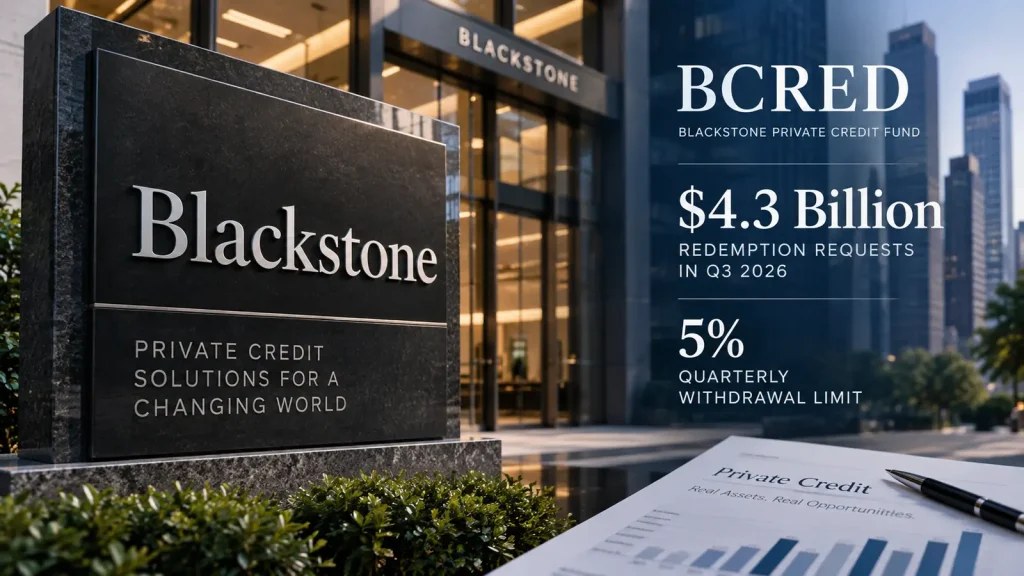
Blackstone Private Credit Fund received an estimated $4.3 billion of share repurchase requests for the third quarter, equivalent to roughly 10% of shares outstanding, forcing the $77.2 billion non-traded business development company to prorate withdrawals at its standard 5% quarterly limit as elevated investor demand for liquidity persisted.
The requests mark another quarter of pressure at BCRED, one of the largest vehicles through which individual investors access Blackstone’s private credit platform. Investors also sought to redeem about 10% of outstanding shares in the second quarter, after first-quarter requests exceeded the fund’s normal quarterly limit.
BCRED’s experience is an important test for the expanding market for perpetual private-market vehicles. Such funds offer periodic liquidity while investing predominantly in assets that cannot necessarily be sold quickly at observable market prices, requiring managers to balance investor withdrawals against portfolio stability.
$2.3 billion of second-quarter requests rolled forward
The third-quarter figure includes investors whose previous requests were not fully met.
In the second quarter, shareholders submitted approximately $4.5 billion of repurchase requests. BCRED fulfilled roughly half, leaving about $2.3 billion unfilled. A significant portion of that amount was resubmitted during the third quarter, according to Blackstone.
The BCRED Sept. 3 shareholder notice said estimated third-quarter requests totaled $4.3 billion, representing approximately 10% of shares outstanding. BCRED will instead repurchase shares equivalent to 5% of outstanding shares, with requests fulfilled proportionately when the offer is oversubscribed.
BCRED said investors seeking liquidity across the second and third quarters will have received an estimated 75% of their requested capital within roughly 90 days, assuming those shareholders requested redemption of their entire holdings in both quarters.
The final dollar amount repurchased will depend on BCRED’s Sept. 30 net asset value and is expected to be disclosed in November.
BCRED records roughly 3% net outflow
The gross redemption figure is larger than the fund’s net capital movement because BCRED continues attracting new subscriptions.
Blackstone estimated third-quarter inflows at nearly $750 million, equivalent to about 2% of NAV. After those subscriptions are considered, the fund expects net outflows of approximately 3% of NAV for the quarter, broadly consistent with the previous two quarters.
The distinction between gross redemption requests and net outflows is significant. A $4.3 billion repurchase request represents shareholder demand for liquidity, but it does not mean $4.3 billion will leave the fund.
BCRED’s quarterly liquidity framework is designed to limit that mismatch. The fund normally offers to repurchase up to 5% of outstanding shares each quarter, subject to board approval, rather than promising unrestricted redemptions.
Blackstone temporarily went beyond that framework earlier this year. In the first quarter, BCRED’s board increased the repurchase amount above the standard 5% threshold and fulfilled all requests, which represented about 7% of outstanding shares. By the second quarter, when requests reached approximately 10%, the fund returned to its normal 5% limit.
$17 billion liquidity buffer limits immediate pressure
Blackstone argues BCRED has sufficient liquidity to manage the withdrawals without forcing asset sales.
The fund reported more than $17 billion of available liquidity, consisting of cash and undrawn borrowing capacity. BCRED also received $2.7 billion in loan repayments during the second quarter. Combined with nearly $750 million of estimated third-quarter subscriptions, those sources are expected to equal about 160% of shares being repurchased this quarter.
BCRED’s debt-to-equity ratio stood at 0.8 times, according to the shareholder notice.
Those figures are important because liquidity risk in private credit differs from credit risk.
A portfolio can continue receiving interest and principal payments even as investors ask for their money back. The potential problem arises when a fund promises more short-term liquidity to shareholders than its underlying private loans naturally generate.
Periodic repurchase limits are intended to prevent that mismatch from forcing managers to sell otherwise performing loans simply to meet withdrawals.
The structure is particularly relevant as asset managers broaden private-credit distribution to wealth investors. PE NEWSWIRE recently examined Capital Group and KKR’s public-private credit strategy, which combines liquid fixed-income assets with private credit while providing monthly repurchase provisions of up to 3% of total assets.
The growth of such products makes liquidity design increasingly important to investors comparing private-market vehicles.
Performance has weakened in 2026
BCRED’s redemption pressure also comes during a softer period for returns.
Class I shares generated a 0.9% total net return during the first seven months of 2026, compared with an 8% full-year return in 2025 and 11% in 2024. The fund reported a 3.7% one-year return through July 31.
Longer-term results remain stronger. Since BCRED’s inception in January 2021, Class I shares have generated a 9% annualized total net return and currently carry a 9.1% annualized distribution rate, according to Blackstone.
The lower 2026 return has coincided with investor scrutiny of individual credit exposures, including software borrowers vulnerable to technological disruption and loans originated when valuations and financing conditions were more aggressive.
Blackstone said the current environment is creating opportunities in areas including AI and digital infrastructure, infrastructure services, aerospace and defense, and life sciences.
The manager is already deploying significant capital into that theme. PE NEWSWIRE recently reported on Blackstone and Apollo’s participation in a $35 billion AI infrastructure financing platform, illustrating how large alternative managers are directing credit capital toward compute infrastructure and other asset-intensive AI investments.
Private credit’s liquidity structure comes under scrutiny
BCRED’s third-quarter repurchase requests arrive as private-credit liquidity has become a broader market issue.
In Australia, several private-credit managers have recently restricted investor withdrawals amid stress surrounding property developer Bathla Group. The circumstances differ substantially from BCRED, but both episodes demonstrate the structural challenge of offering periodic investor liquidity against portfolios dominated by privately originated loans.
BCRED has not suspended withdrawals. Instead, its 5% quarterly limit is an established feature of the vehicle.
The BCRED offering terms explicitly state that quarterly repurchases are limited to 5% of aggregate shares outstanding, subject to board approval, and that investors should not assume they can sell shares whenever they choose. The board can also amend or suspend repurchases if it determines doing so is in shareholders’ interests.
That distinction is central to interpreting the $4.3 billion figure. Blackstone is not imposing an unexpected gate on a fund that promised daily liquidity; BCRED is applying the normal limit built into its structure after requests exceeded available quarterly capacity.
Still, repeated oversubscription is meaningful.
Three consecutive quarters of elevated requests would indicate that a material group of investors is seeking liquidity faster than BCRED’s normal repurchase mechanism can provide it. The $2.3 billion backlog from the second quarter also shows how unfulfilled requests can carry into subsequent tender periods.
Next quarter will test whether redemption pressure eases
BCRED’s liquidity position means the immediate issue is less about its ability to fund the third-quarter tender than about the persistence of redemption demand.
If shareholders whose requests are only partially satisfied continue resubmitting them, the fund could enter subsequent quarters with an inherited pool of withdrawal demand before receiving new requests.
Conversely, loan repayments, fresh subscriptions and stronger investment performance could reduce that pressure.
BCRED’s scale provides meaningful resources to manage the cycle. With $77.2 billion of assets, more than $17 billion of available liquidity and billions of dollars of portfolio repayments, the fund is not dependent on selling loans to satisfy every investor requesting cash this quarter.
But the episode provides a closely watched test for the broader private-wealth expansion of private credit.
Alternative managers have spent years creating perpetual vehicles that make institutional-style private assets accessible to a wider investor base. Those structures depend on investors understanding that periodic repurchase programs provide limited liquidity rather than the on-demand liquidity associated with mutual funds or exchange-traded securities.
BCRED’s $4.3 billion of third-quarter requests puts that distinction into practical terms. The next test will be whether redemption demand normalizes — or whether the 5% quarterly cap continues leaving shareholders waiting for liquidity into 2027.