
World Bank Draws $112 Billion of Private Capital Into Emerging Markets

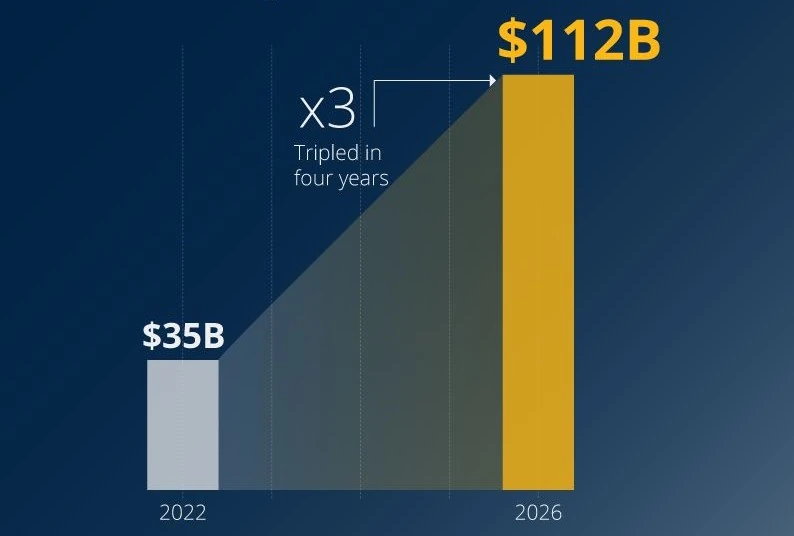
The World Bank Group mobilized a record $112 billion of private capital in fiscal 2026, more than tripling the $35 billion recorded four years earlier as the development lender expanded guarantees and other structures designed to draw institutional money into developing economies.
Combined with the World Bank Group’s own financing, total financing and mobilization in developing economies exceeded $200 billion in FY2026. The increase provides a measure of how multilateral development banks are increasingly using their balance sheets to attract private investors rather than relying solely on direct development lending.
The World Bank Group disclosed the figures in its private capital mobilization announcement, saying the $112 billion was the highest annual total in its history.
Private capital more than triples in four years
Mobilization increased across most of the World Bank’s developing-market income groups.
Private capital mobilized for lower-middle-income countries rose from $14 billion in FY2022 to $37 billion in FY2026, while the amount directed to upper-middle-income economies increased from $12 billion to $50 billion.
Africa recorded particularly strong growth. Private capital mobilization across the continent increased from approximately $9 billion to $22 billion, an increase of nearly 150% over four years.
Low-income countries proved more difficult to scale, with mobilization remaining at approximately $3 billion. The disparity illustrates a continuing challenge for institutional investors: private capital is growing rapidly in developing markets, but deployment remains substantially easier where projects have stronger credit profiles, regulatory frameworks and risk-adjusted economics.
That divide matters for private-market investors assessing emerging-market allocations. Larger pools of institutional capital can potentially finance infrastructure, energy, healthcare and other real assets, but currency risk, political risk and project economics can make the least-developed markets harder to access without credit enhancement.
Guarantees pass $25 billion
One of the strongest increases came from guarantees.
The World Bank Group issued more than $25 billion of guarantees in FY2026, already exceeding its target of $20 billion in annual issuance by 2030. The institution attributed much of the expansion to the World Bank Group Guarantee Platform, established in 2024 to provide a single access point for guarantee products.
Guarantees can be particularly important for private infrastructure and credit investors because they transfer or mitigate specific risks that might otherwise prevent institutional capital from entering a project.
The World Bank has also expanded local-currency financing, foreign-exchange risk tools and equity instruments as part of its effort to lower investment barriers.
The expansion comes as institutional investors continue searching for opportunities beyond established developed markets. PE NEWSWIRE recently reported that India private capital fundraising reached a record $23.7 billion in 2026, with infrastructure and other private-market strategies contributing to a broader increase in capital formation.
World Bank looks to package loans for institutional investors
The next phase could be more directly relevant to pension funds, insurers and alternative asset managers.
The World Bank Group is developing an originate-to-distribute model that packages investments into securities that can be distributed to institutional investors, potentially allowing private capital to participate in emerging-market credit at greater scale.
The strategy has already moved beyond planning. In June, the World Bank Group completed a $509 million emerging-markets collateralized loan obligation, packaging 62 IFC-originated loans across sectors and countries into rated securities. Together with its inaugural 2025 transaction, the program has issued more than $1 billion of securities. The World Bank’s second emerging-markets CLO announcement details the structure and its role in the institution’s originate-to-distribute strategy.
The model resembles a broader shift across private markets toward structures that separate origination from long-term ownership. By originating loans, packaging diversified portfolios and distributing securities, the World Bank can recycle capital while creating instruments potentially better suited to institutional portfolios.
For asset managers, that could expand the investable universe of emerging-market private credit without requiring investors to originate individual loans across multiple jurisdictions.
Infrastructure and energy remain central
The World Bank said 55% of its total FY2026 financing and mobilized capital went to five sectors it considers particularly important for job creation: infrastructure and energy, agribusiness, healthcare, tourism and value-added manufacturing.
Infrastructure is especially relevant to long-duration institutional capital because projects in energy, transport and digital networks can match the investment horizons of pension funds, insurers and infrastructure managers.
PE NEWSWIRE has tracked the growing role of institutional capital in such assets, including CPP Investments’ $1.75 billion commitment to an EQT-led AI data-center expansion. The World Bank’s approach targets a different risk and geographic profile, but both reflect institutional demand for long-duration infrastructure exposure.
The challenge is converting that demand into investable projects in markets where currency volatility, regulatory uncertainty and sovereign risk can limit allocations.
The World Bank’s FY2026 figures suggest guarantees and structured distribution are beginning to bridge part of that gap. But the geographic breakdown also shows the limits: while mobilization quadrupled in upper-middle-income countries, it remained roughly flat in low-income economies.
For private-market investors, the more consequential development may therefore be the infrastructure being built around the capital itself. If guarantees, standardized loans and securitization can make emerging-market assets easier to underwrite and trade, the World Bank could increasingly function not only as a development lender but also as an originator and risk-sharing platform connecting global institutional capital with developing economies.