Andreessen Horowitz Leads $17M Investment in Dream’s AI Construction Platform

Dream, an artificial intelligence startup founded by former Palantir executives Andy Alder and Arjun Mather, emerged from stealth with $17 million in seed funding led by venture capital firm Andreessen Horowitz.
The financing, which also attracted SV Angel, XYZ and Zigg Capital, backs Dream’s development of AI systems designed to automate building design and engineering. The company is targeting commercial construction projects, where architectural planning, structural engineering and building systems must be coordinated before construction begins.
Dream enters the market with a technology platform that it says has already been deployed on 10 active projects in California and Texas. Its approach focuses on generating technically coordinated building plans rather than conventional architectural visualizations.
Dream Targets Commercial Building Design With AI
Dream is developing what it calls built world models, artificial intelligence systems trained to understand the physical relationships, structural requirements and engineering constraints involved in constructing buildings.
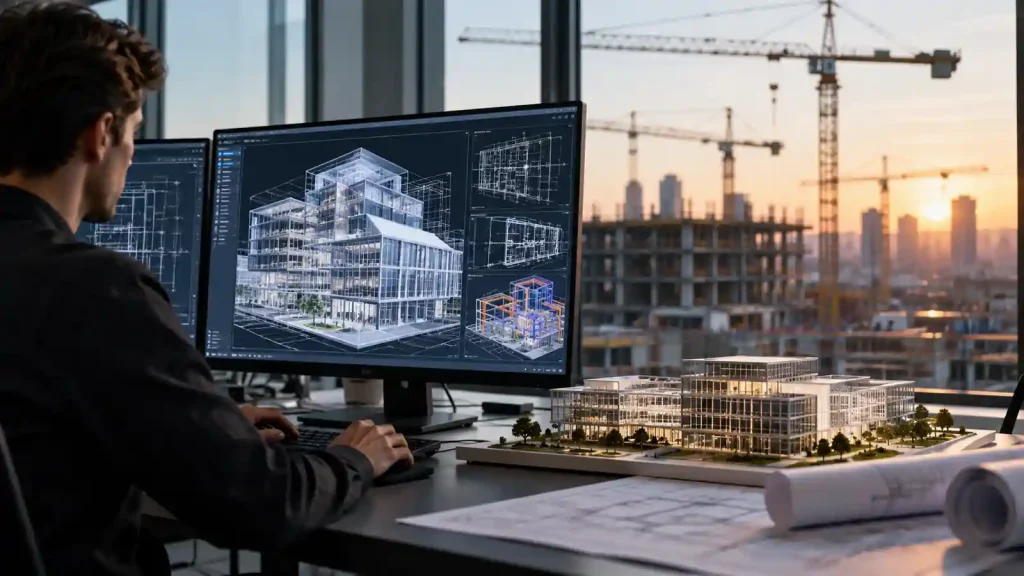
Unlike image-generation software that produces visual representations of architectural concepts, Dream says its technology can generate building plans incorporating structural components, plumbing, electrical infrastructure and heating, ventilation and air conditioning systems.
The company describes the underlying capability as structural cognition, referring to an AI model’s ability to account for how building components interact within a physical structure.
According to Dream’s official product and technology announcement, the platform has been trained on data representing more than 100 million square feet of buildings.
The company says its software can evaluate thousands of design alternatives in minutes while checking configurations against relevant construction constraints and building codes.
Dream initially focuses on commercial properties, including offices, retail facilities and data centers. Its service is intended to produce construction documents that contractors can use, rather than limiting its output to preliminary design concepts.
These capabilities are company-reported and have not been independently benchmarked across different construction projects or regulatory jurisdictions.
Former Palantir Executives Lead the Company
Dream was established by Andy Alder and Arjun Mather, who previously spent approximately a decade working at Palantir Technologies.
Alder held a product-design leadership position supporting software development for U.S. defense and intelligence customers. Mather served as a senior vice president within Palantir’s commercial business.
Their backgrounds provide experience in enterprise software and complex operational systems, although neither founder entered the venture with a professional background in architecture or construction engineering.
The founders established Dream in 2025 to address inefficiencies in the design and engineering processes used throughout the architecture, engineering and construction industry.
Andreessen Horowitz partner Kimberly Tan said the venture capital firm initially invested in Dream more than a year before its public launch, when the technology remained at an early conceptual stage.
The companies have not publicly disclosed Dream’s valuation, the ownership stakes acquired by investors or detailed financial terms of the seed financing.
Construction Software Presents an Opportunity for Venture Capital
Dream’s investment proposition centers on replacing parts of the traditional building-design workflow with AI-driven automation.
Established architecture and engineering software platforms, including Autodesk’s AutoCAD and Revit, provide tools for drafting, modeling and coordinating construction plans.
Dream is pursuing a different approach: generating integrated building designs from project requirements, site characteristics and engineering constraints.
For developers, the potential economic benefit extends beyond reducing the time required to produce architectural drawings.
Design revisions can affect construction budgets, material specifications, engineering coordination and project schedules. Software capable of evaluating these dependencies earlier could help developers compare alternatives before committing substantial capital to construction.
However, achieving those benefits depends on whether automated plans can consistently satisfy structural requirements, local building regulations and professional review standards.
Dream’s positioning also differs from AI tools focused primarily on improving the productivity of individual architects. Its commercial offering is designed to automate a larger portion of the building-design process.
Early Deployments Provide a Test of Commercial Adoption
Dream reports that its technology is being used across 10 active projects in California and Texas.
The company also says it serves as architect of record on construction projects in those states, positioning its offering as a professional design service supported by proprietary AI technology.
That distinction matters for investors evaluating the business model.
A software product that assists architects with isolated tasks faces different commercial requirements from a platform responsible for delivering coordinated construction documentation.
The latter must address professional accountability, design validation, regulatory compliance and integration with contractors and engineering specialists.
Dream has not disclosed annual recurring revenue, customer concentration, contract values or the proportion of project design work completed without human intervention.
Its 10 active projects demonstrate early deployment, but they do not establish that the technology has delivered completed buildings or independently verified construction-cost savings.
AI Construction Startups Face Established Software Providers
Dream is entering a market that includes both established construction software companies and venture-backed startups developing AI-assisted design tools.
Companies such as Motif, Snaptrude and Arcol are also pursuing opportunities in architecture and construction software.
Competition is likely to depend on more than the speed at which platforms generate designs.
Professional users must be able to evaluate the accuracy of generated plans, integrate outputs into existing workflows and demonstrate compliance with applicable building standards.
For commercial developers, the ability to replicate a standardized building design across multiple locations could be particularly relevant.
Retail chains, hospitality operators and other businesses undertaking repeated property developments often need to adapt similar layouts to different sites, infrastructure requirements and local regulations.
Dream says its models can adapt prototype designs while reassessing the structural and regulatory constraints of each location.
This creates a potential application beyond individual building projects, although the commercial effectiveness of the approach remains unproven at scale.
What the $17M Financing Means for Investors
Dream’s seed financing represents an early-stage venture capital investment in AI infrastructure for the physical economy.
The company’s approach differs from general-purpose generative AI businesses because its proposed value depends on industry-specific engineering data, technical accuracy and integration with regulated professional workflows.
For venture investors, the central question is whether Dream can convert its underlying technology into a repeatable commercial product with attractive economics.
Its ability to generate designs is one measure of technical progress. The more important commercial indicators will include customer retention, project delivery performance, design accuracy, regulatory acceptance and the cost of providing services.
The involvement of Andreessen Horowitz and three additional venture investors gives Dream institutional backing as it begins demonstrating its technology in commercial construction.
The next stage of development will test whether its AI models can move beyond early deployments and support a broader range of building types, geographic markets and engineering requirements.