Nvidia’s $500 Billion AI Financing Partnerships Face Uncertainty Following Jensen Huang’s Exit

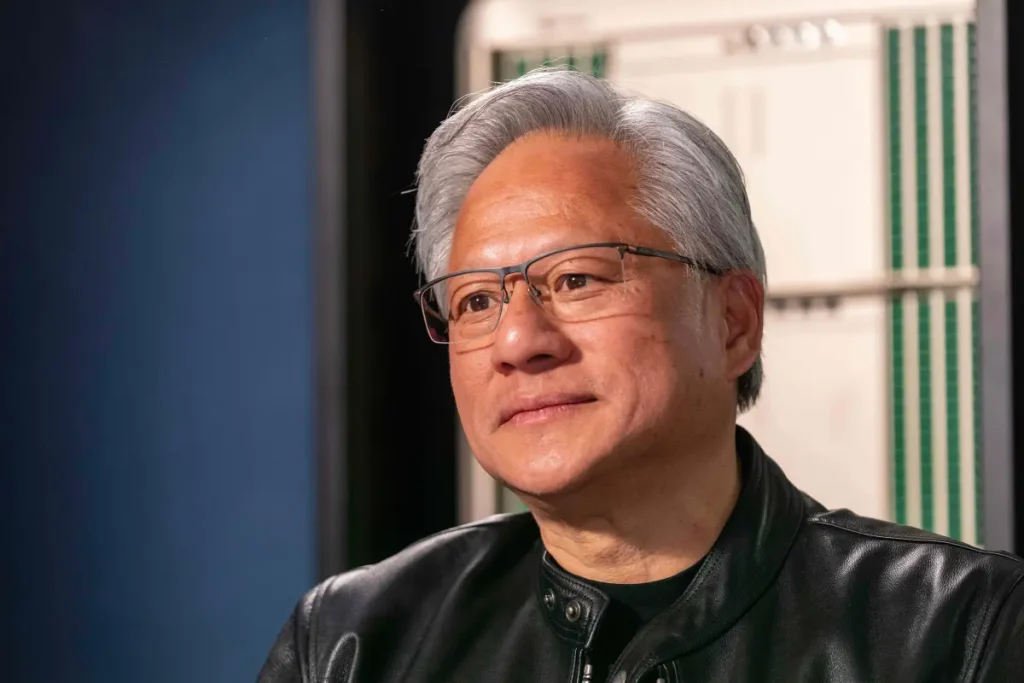
Jensen Huang’s resignation from Nvidia has raised questions about the future of an artificial intelligence financing strategy he personally championed, including partnerships with six major financial institutions intended to mobilize more than $500 billion in third-party capital.
The strategy, developed under Huang’s leadership, linked Nvidia’s semiconductor business to private equity, infrastructure investment, private credit and venture capital. It also connected the company’s financial interests to AI developers and cloud operators, creating exposures that institutional investors may need to reassess.
Huang resigned Nov. 11, 2026, with Nvidia announcing his departure the following day. Chief Financial Officer Colette Kress became interim CEO, while Harvey Jones was appointed board chair.
The central question for alternative asset managers is whether Nvidia’s next leadership team will preserve the investment commitments, financing guarantees and commercial relationships that helped fund the AI infrastructure expansion.
Huang’s $500 Billion Private Capital Initiative
One of Huang’s most consequential initiatives was Nvidia’s August 2026 agreement with Apollo Global Management, BlackRock, Blackstone, Brookfield, Goldman Sachs and KKR.
The Nvidia financing partnership announcement outlined plans to establish investment platforms capable of mobilizing more than $500 billion of institutional capital over time.
The arrangements were based on memorandums of understanding, not completed fundraising or fully deployed investments.
Huang personally presented the strategy as a way to transform AI computing capacity into an institutional investment asset.
The proposed platforms would finance computing infrastructure used by AI laboratories, cloud operators and enterprises, potentially creating opportunities for infrastructure funds, private credit managers and other long-duration investors.
For Apollo, Blackstone, Brookfield and KKR, the investment opportunity depends on whether computing infrastructure can generate sufficiently predictable cash flows to support institutional underwriting.
Huang’s departure introduces leadership uncertainty, but Nvidia has not announced the cancellation of these partnerships.
OpenAI and Anthropic: Equity Capital Meets Computing Demand
Huang also helped establish Nvidia as a strategic investor in leading private AI developers.
In February 2026, OpenAI announced a $110 billion financing round involving $30 billion from Nvidia, $30 billion from SoftBank and $50 billion from Amazon.
The financing followed an earlier proposal under which Nvidia contemplated investing up to $100 billion as OpenAI deployed additional computing infrastructure. That original figure was not equivalent to a completed investment.
Nvidia also committed capital to Anthropic through an investment arrangement of up to $10 billion.
These transactions created relationships in which Nvidia could benefit from equity appreciation while the recipient companies purchased computing capacity powered by Nvidia technology.
For venture capital investors and secondary buyers holding interests in AI developers, such arrangements raise important valuation questions.
A private company’s financing round may establish a headline valuation, but its future performance depends on customer revenue, infrastructure costs and continued access to capital.
Changes in Nvidia’s strategic investment policy could therefore influence future financing negotiations without necessarily changing the value of existing contractual commitments.
CoreWeave and Nebius: Strategic Investments With Infrastructure Exposure
Nvidia’s relationships with CoreWeave and Nebius illustrate how Huang’s strategy extended beyond AI software developers.
In January 2026, Nvidia invested $2 billion in publicly traded CoreWeave at $87.20 per share, alongside an expanded infrastructure partnership targeting more than five gigawatts of computing capacity by 2030.
In March, Nvidia announced a separate $2 billion investment in Nebius, supporting another planned multigigawatt AI cloud expansion.
Both companies combine substantial capital expenditure requirements with commercial relationships involving Nvidia technology.
For infrastructure lenders, the key considerations include customer concentration, equipment depreciation, financing costs and the reliability of contracted revenue.
Nvidia’s equity participation provides strategic alignment, but it does not eliminate credit risk.
The Secondaries Connection: Who Ultimately Owns AI Infrastructure Risk?
The most significant secondary-market implications arise from the growing institutional ownership of AI infrastructure rather than from any confirmed sale of Nvidia-backed assets.
As private capital finances data centers, computing equipment and related businesses, investors acquire fund interests and portfolio exposures that may eventually enter secondary transactions.
LP-led secondary buyers must assess whether reported net asset values adequately reflect financing obligations, technology replacement costs and dependence on major customers.
GP-led continuation funds face similar questions when sponsors seek additional holding periods for capital-intensive infrastructure assets.
The issue becomes more complicated when Nvidia acts simultaneously as technology supplier, strategic investor and financing supporter.
In its August 2026 earnings-call transcript, Nvidia discussed nearly $50 billion invested in frontier AI laboratories and its efforts to establish financing platforms with institutional capital providers.
The company also acknowledged concerns about interconnected financing arrangements while defending the commercial economics of its investments.
For secondary buyers, the relevant question is whether underlying portfolio valuations assume continued strategic support from Nvidia.
Any withdrawal or reduction of that support could affect financing assumptions, although no broad repricing of these investments has been established.
What Changes Without Huang?
Huang’s personal involvement helped connect Nvidia with AI developers, financial institutions and infrastructure operators. His departure creates uncertainty around the future direction of those relationships.
Nevertheless, Nvidia’s corporate investments are legally distinct from Huang’s personal shareholdings. Public disclosures do not establish that the investments discussed were made for his undisclosed personal benefit.
Kress now inherits a strategy involving equity investments, financing commitments and partnerships spanning multiple private-market asset classes.
For institutional investors, the priorities are the continuity of existing agreements, future capital allocation, counterparty exposure and the ability of financed assets to generate sustainable returns.
The next phase of Nvidia’s strategy will help determine whether Huang’s AI financing model becomes a durable institutional asset class or requires more conservative underwriting.
For private equity, private credit and secondaries managers, that distinction matters more than the immediate market reaction to his resignation.