AI Stock Sell-Off Exposes Billions in Hidden Risks Across Hedge Funds, Private Credit and Private Equity


Hedge funds are surrendering gains, private lenders face mounting credit risks, and private equity firms confront an increasingly difficult exit market. With billions tied to the artificial intelligence (AI) boom, the latest AI stock sell-off is exposing vulnerabilities across alternative investments.
The AI boom that helped propel global markets to extraordinary valuations is now delivering a painful reckoning for some of Wall Street’s most sophisticated investors. The recent technology-led stock sell-off has erased trillions in equity value, inflicted substantial losses on hedge funds, unsettled private credit markets and threatened the exit strategies underpinning private equity valuations.
The central concern is no longer simply whether AI companies can sustain their growth. It is whether the alternative investment industry has committed too much capital, leverage and confidence to an expansion whose financial returns remain uncertain.
For hedge fund managers, private credit executives and private equity sponsors, the consequences could extend well beyond the current market correction.
Hedge Funds: Crowded AI Trades Turn Into Major Losses
Hedge funds have emerged among the most immediate casualties. According to Reuters, Goldman Sachs estimated technology-focused equity long-short funds lost more than 4% on November 5 alone, leaving their annual returns approximately flat after reaching gains of 24% in June. Global fundamental long-short managers declined 1.3%, while multi-strategy funds lost 1.4% that day.
JPMorgan estimated that global hedge funds lost approximately 3% during October, underscoring the scale of the reversal. Kitco News+1
The pressure is extending beyond investment performance into operational decisions.
Walleye Capital, the $17 billion multi-strategy hedge fund, disclosed plans to reduce its internal equity long-short operations, cut investment personnel and return a portion of investor capital following its worst month since March 2020.
The broader danger lies in portfolio concentration. Hedge funds that appeared diversified across managers and strategies increasingly held overlapping positions in AI infrastructure, semiconductor companies and hyperscale technology businesses.
As losses force managers to reduce leverage, simultaneous selling could amplify volatility, potentially creating additional losses even for funds with otherwise sound investment strategies.
Private Credit: AI’s Debt-Fueled Expansion Faces Its First Serious Test
While hedge fund losses are already visible in market performance, private credit’s potential damage could emerge more gradually.
The AI infrastructure expansion has attracted enormous financing commitments covering data centers, advanced processors, electricity infrastructure and computing capacity. Private credit managers have increasingly participated in these transactions, seeking attractive yields and long-term contractual income.
However, slowing investment growth, higher financing costs and uncertainty over future demand could undermine assumptions supporting some loans.
Moody’s Ratings warned in October that substantial AI-related borrowing maturities between 2027 and 2029 could leave weaker borrowers struggling to refinance. Approximately 17% of the 607 borrowers tracked by the agency used payment-in-kind interest, allowing interest obligations to accumulate rather than requiring immediate cash payments.
CoreWeave illustrates the emerging pressure. Reuters reported that the AI infrastructure company’s debt faced significant market stress in October, with some bond yields climbing toward 15%–16% and default-protection costs rising sharply.
Banks and credit investors have since become more selective about additional AI exposure, including transactions supported by major technology companies.
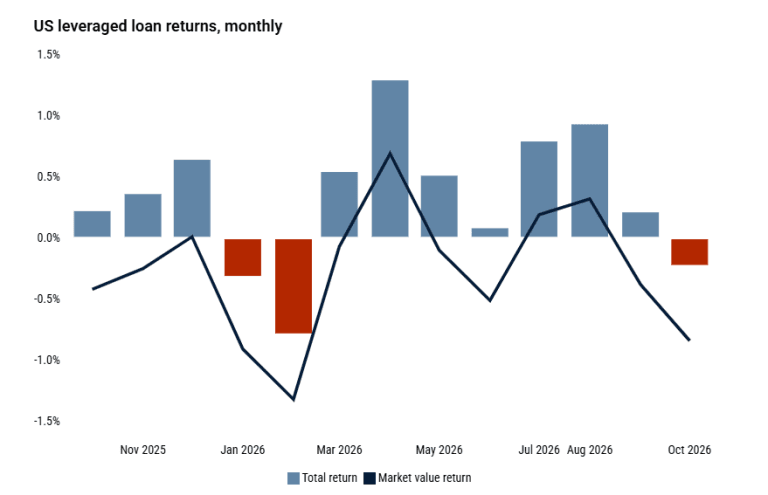
For private credit funds, the critical distinction is between market-implied credit deterioration and actual loan defaults. Widening spreads do not automatically mean realized losses, but refinancing difficulties, weaker collateral values and deteriorating borrower cash flows could eventually translate into restructurings and impaired recoveries.
The industry’s next challenge may therefore be determining whether loans originated during the AI boom can withstand a materially less favorable financing environment.
Private Equity: IPO Delays Threaten Exit Strategies and Investor Returns
Private equity firms face a different but potentially prolonged challenge: disappearing exit opportunities.
A once-promising technology IPO calendar has narrowed dramatically. Switch, Nscale and SB Energy postponed listing plans, while Blackstone-backed AirTrunk REIT and Nvidia-backed Firmus paused or withdrew offerings.
Anthropic remains the most prominent potential exception. The AI developer is pursuing a blockbuster public offering that could value the company at approximately $1.4 trillion, although its proposed valuation and timing face significant investor scrutiny.
For private equity sponsors, delayed listings create consequences beyond postponed transactions.
Funds holding mature portfolio companies may struggle to distribute capital to limited partners, while declining public-market valuations complicate private-company pricing and negotiations with prospective buyers.
S&P Global Market Intelligence reported that global private equity and venture capital exit transactions declined 17.4% year over year in the third quarter of 2026.
Meanwhile, Blackstone reported a 34% decline in net realizations, highlighting how difficult market conditions are affecting even the largest alternative asset managers.
The risk is a widening disconnect between portfolio valuations, achievable exit prices and investors’ expectations for liquidity.
The Bigger Threat: A Contagion Across Alternative Investments
The greatest concern is that these pressures may reinforce one another.
Hedge fund deleveraging can depress publicly traded valuations. Falling valuations can weaken collateral assumptions and financing conditions for private lenders. More expensive credit can reduce leveraged buyout activity, while delayed IPOs leave private equity sponsors holding investments longer than anticipated.
This does not necessarily signal an industry-wide crisis. Stronger borrowers, well-capitalized funds and managers with available liquidity may benefit from distressed valuations and wider credit spreads.
Nevertheless, the market is entering a period in which investment discipline, financing resilience and actual cash generation could matter more than exposure to the AI growth narrative.
For alternative investment executives, the defining question is shifting from how much capital they can deploy into AI to how much risk their portfolios can withstand if the boom delivers returns more slowly than expected.
The answer could determine which managers preserve investor confidence—and which spend the next several years repairing the consequences of an overcrowded trade.