US Leveraged Loans Lose 0.22% in October as Credit Weakness Spreads Beyond Software

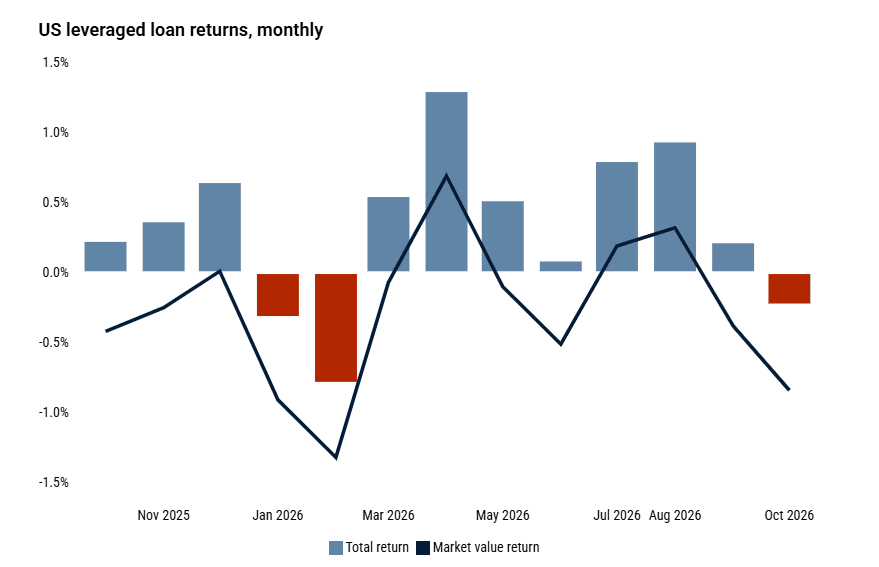
October 2026 US leveraged loan market decline and private equity refinancing risks - Sources: PitchBook
The US leveraged loan market recorded its first monthly loss since February in October 2026, as falling secondary-market prices, weaker demand and increased acquisition financing pushed credit-market pressure beyond the software industry.
The Morningstar LSTA US Leveraged Loan Index returned negative 0.22% for October, while its market-value component declined 0.84%. The deterioration coincided with approximately $49 billions of buyout and M&A-related loan issuance over September and October, shifting the balance between institutional demand and new debt supply.
According to a latest published PitchBook LCD data, the decline has implications for private equity sponsors, collateralized loan obligation (CLO) managers and institutional credit investors. Lower secondary prices can increase financing costs for leveraged borrowers even as new acquisition-related issuance creates opportunities for lenders to demand better terms.
Leveraged Loan Prices Retreat From September Highs
The weighted average bid for loans in the Morningstar LSTA US Leveraged Loan Index fell from 95.69 cents on the dollar on Sept. 22 to 94.25 cents by Oct. 26.
That brought the index close to its March 3 low of 94.17 before prices recovered modestly to 94.52 at the end of October.
The monthly loss interrupted a recovery that had supported leveraged loan returns through much of 2026.
Despite the October decline, the index generated a positive 3.06% total return over the first 10 months of the year. That compared with 4.86% during the corresponding period in 2025 and 7.45% in 2024.
The difference reflects both weaker secondary-market performance and reduced interest income relative to earlier periods.
Floating-rate loans can continue generating positive coupon income while their market values decline. However, sustained price weakness can reduce total returns and complicate portfolio management for investors holding lower-rated corporate debt.
The Loan Syndications and Trading Association’s October market analysis identified increased net supply and weaker demand as central drivers of the market’s deterioration. finance.yahoo.com+1
Software Loans Stabilize as Other Industries Weaken
October’s most important development was the changing composition of the sell-off.
Earlier weakness had been concentrated in software borrowers, where concerns about artificial intelligence disrupting established business models weighed heavily on debt valuations.
During October, however, performing non-software loans experienced a sharper decline than software debt.
Average non-software loan bids fell 84 basis points to 95.90 cents on the dollar, their lowest level in three years. Software loan bids declined 41 basis points to 87.33.
The software segment nevertheless remained substantially weaker in absolute price terms.
Software loans returned a positive 0.11% during October, including interest income, but remained down 1.61% for the year. Cyclical and consumer-facing borrowers accounted for much of the broader market’s weakness.
The distinction matters for credit investors. Software exposure remains a significant portfolio risk, but October’s losses indicate that underwriting concerns can no longer be assessed solely through technology-sector concentration.
An October analysis from PIMCO also identified continuing valuation differences among software borrowers, reflecting uneven exposure to AI disruption, refinancing costs and business-model risk.
PIMCO’s assessment of software loan valuations and refinancing conditions found that some borrowers could extend maturities with relatively modest spread increases, while others faced substantially more expensive financing.
For lenders, this creates a stronger incentive to differentiate borrowers by cash-flow resilience, competitive positioning and debt-service capacity rather than sector classification alone. PIMCO
Lower-Rated Borrowers Face Greater Refinancing Pressure
The deterioration was particularly pronounced among the lowest-rated leveraged loans.
Loans rated triple-C generated a negative 2.87% return in October, their weakest monthly performance since February. Their year-to-date return fell to negative 8.68%.
By comparison, double-B loans declined just two basis points during October.
Approximately 63% of outstanding triple-C debt in the index matures by 2029, creating a concentrated refinancing challenge for borrowers already facing elevated funding costs.
The divergence between double-B and triple-C performance suggests investors are increasingly distinguishing between stronger borrowers and companies with limited financial flexibility.
For private equity sponsors, that distinction could influence refinancing negotiations, acquisition financing and the timing of portfolio-company exits.
PE NEWSWIRE previously examined the approximately $300 billion refinancing challenge facing private equity-backed companies, including substantial below-investment-grade maturities scheduled for 2028 and 2029.
A prolonged period of discounted loan prices could make those maturities more difficult to address, particularly for companies with weak earnings growth or limited capacity to absorb higher interest expenses.
Acquisition Financing Creates a $2.6 Billion Supply Imbalance
The October decline also reflected a shift in the technical balance of the syndicated loan market.
Buyout and M&A-related issuance totaled approximately $49 billion during September and October, representing the largest net supply inflow from such activity since 2022.
October alone recorded $18.3 billion of M&A-related issuance.
The additional financing contributed to a $2.6 billion net supply surplus as demand failed to absorb new loans at previously prevailing prices.
Meanwhile, opportunistic refinancing, repricing and maturity-extension transactions totaled just $11.4 billion during October.
These transactions typically become more attractive when strong investor demand allows borrowers to reduce spreads or extend maturities on favorable terms.
Their slowdown indicates that borrowers faced less favorable conditions for renegotiating existing debt.
The shift contrasts with the unusually competitive lending conditions observed earlier in 2026.
PE NEWSWIRE’s previous analysis of U.S. leveraged buyout loan pricing found that average spreads on newly issued buyout loans had declined to approximately 307 basis points above benchmark rates in the third quarter, while compensation relative to borrower leverage reached its lowest level since 2007.
October’s deterioration suggests that the balance of negotiating power has started shifting toward lenders.
However, wider spreads and lower loan prices do not necessarily mean acquisition financing will disappear. Stronger borrowers may continue accessing institutional markets, while weaker companies face higher costs or more restrictive structures.
What the Loan Sell-Off Means for Private Equity and CLO Investors
For private equity sponsors, the consequences extend beyond the immediate decline in loan-market returns.
Higher financing spreads can reduce the debt capacity available for acquisitions, increasing the equity contribution required from sponsors.
Lower debt capacity can also affect purchase-price negotiations, particularly for transactions previously underwritten using cheaper financing assumptions.
Existing portfolio companies approaching maturity may need to negotiate extensions, refinance at higher costs or seek additional sponsor support.
CLO managers face a different set of considerations.
Lower secondary prices can create opportunities to purchase loans at discounts, but those discounts may also reflect deteriorating borrower fundamentals and greater default risk.
Managers must balance potential price appreciation against credit-rating migration, portfolio concentration and the likelihood of principal losses.
The distinction between market volatility and fundamental credit deterioration is particularly important for triple-C exposures, where refinancing difficulties can translate into restructurings or defaults.
Credit Selection Becomes More Important Heading Into Year-End
October’s market performance points to three developments institutional investors will need to monitor: the pace of new acquisition-related issuance, the ability of CLO demand to absorb that supply and the refinancing prospects of lower-rated borrowers.
The October sell-off did not erase the leveraged loan market’s positive year-to-date return. Nevertheless, the combination of weaker secondary prices, reduced opportunistic issuance and widening sector exposure marks a meaningful change from the more supportive financing conditions earlier in 2026.
For private equity sponsors, the immediate priority is assessing whether portfolio-company debt structures remain sustainable under less favorable refinancing assumptions.
For institutional lenders, the opportunity is to demand stronger compensation and protections without assuming that every discounted loan represents an attractive investment.
The market’s next test will be whether stronger credits can continue attracting financing while lower-rated borrowers absorb the consequences of higher funding costs and increasingly selective institutional demand.