

US Buyout Loan Risk Premium Hits Lowest Level Since 2007 as Debt Supply Tightens

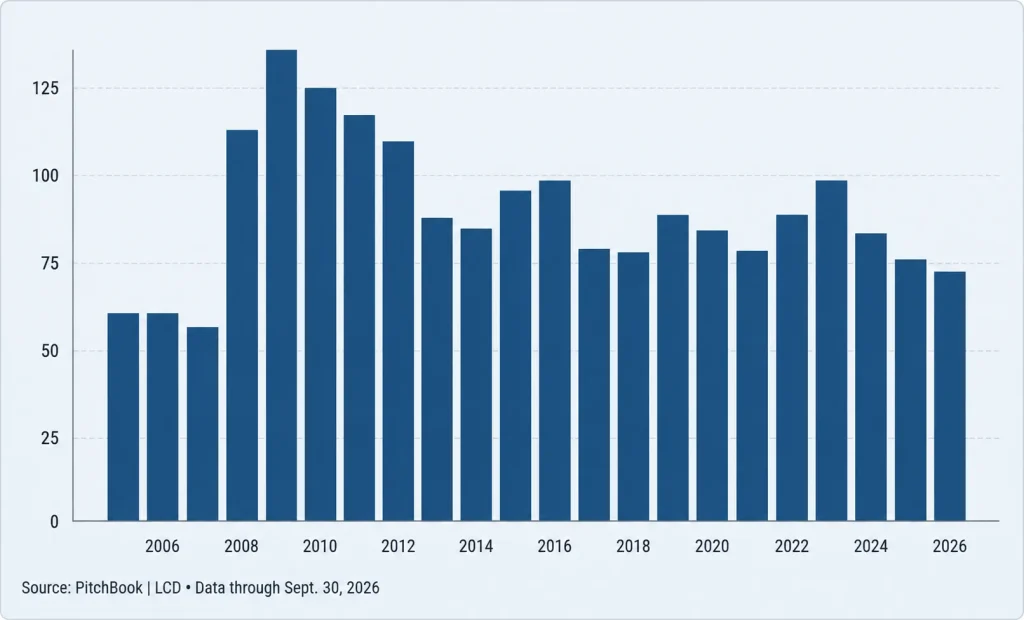
US leveraged buyout lenders are receiving lowest compensation for leverage risk since 2007, as limited new financing supply intensifies competition among investors in broadly syndicated loans.
The compression creates more favorable financing conditions for private equity sponsors pursuing acquisitions and refinancings, although it also raises questions about whether credit investors are being adequately compensated for leveraged borrowers’ financial risks.
LBO Loan Pricing Reflects Strong Investor Competition
Average spreads on newly issued leveraged buyout loans reached approximately 307 basis points above the benchmark rate in the third quarter of 2026, compared with 330 basis points in the first quarter.
According to PitchBook LCD data published Oct. 21, 2026, the spread-per-unit-of-leverage measure, which evaluates credit spreads relative to borrowers’ debt multiples, fell to approximately 73 basis points from 100 basis points in 2023.
This metric provides a more comprehensive assessment of lending economics than nominal spreads alone because it accounts for the leverage supporting each transaction.
The declining risk premium indicates that lenders are accepting less incremental compensation for the financial leverage embedded in buyout transactions.
The distinction is important: lower spreads do not necessarily mean individual borrowers have become riskier. Loan pricing also reflects changes in leverage, sponsor equity contributions and the quality of companies accessing the market.
Limited Supply Strengthens Borrower Negotiating Power
Competition for a relatively small pipeline of new transactions has helped private equity sponsors negotiate more attractive financing terms.
Institutional investors seeking floating-rate credit exposure must compete for available loans, particularly when acquisition financing volumes are insufficient to absorb investment demand.
Recent market conditions illustrate this imbalance. In its October leveraged loan market commentary, Voya Investment Management reported institutional loan issuance of $12.1 billion during the week ending Oct. 8, a 90% increase from the preceding week.
However, short-term issuance increases do not necessarily resolve the broader shortage of new acquisition-related debt.
For private equity sponsors, tighter spreads can improve acquisition financing economics and reduce interest costs on refinanced portfolio-company debt.
Private Credit Faces a Different Pricing Environment
The broadly syndicated loan market’s tightening contrasts with conditions in private direct lending.
US direct lending volume declined to $38.9 billion in the third quarter, its lowest quarterly level since the second quarter of 2023, while large-cap private lending spreads reached approximately 516 basis points in September, reflecting a substantial premium over comparable syndicated credit benchmarks.
The difference creates refinancing opportunities for borrowers capable of accessing public syndicated markets, while direct lenders continue serving transactions requiring greater structuring flexibility.
Implications for Private Equity and Credit Investors
For buyout sponsors, lower financing spreads can improve projected equity returns, particularly when acquisition valuations and operating performance remain unchanged.
For lenders, reduced compensation increases the importance of underwriting discipline, covenant protections and borrower cash-flow resilience.
The market also presents a distinction between financing availability and overall credit quality. Competitive pricing can coexist with weaker performance among particular borrowers or industries.
Ultimately, the sustainability of current loan spreads will depend on whether acquisition financing supply recovers sufficiently to rebalance competition between borrowers and institutional lenders.
PE NEWSWIRE has previously covered JPMorgan’s $3 billion buyout financing for Warburg Pincus, an example of bank-led lending competing with private credit for large sponsor transactions.
Its reporting on EQT’s $2 billion McGill acquisition and $400 million private credit financing illustrates why direct lenders remain relevant even when syndicated borrowing costs are more competitive.