
Bond Market Pressure Tightens U.S. Financial Conditions Amid Debt Concerns

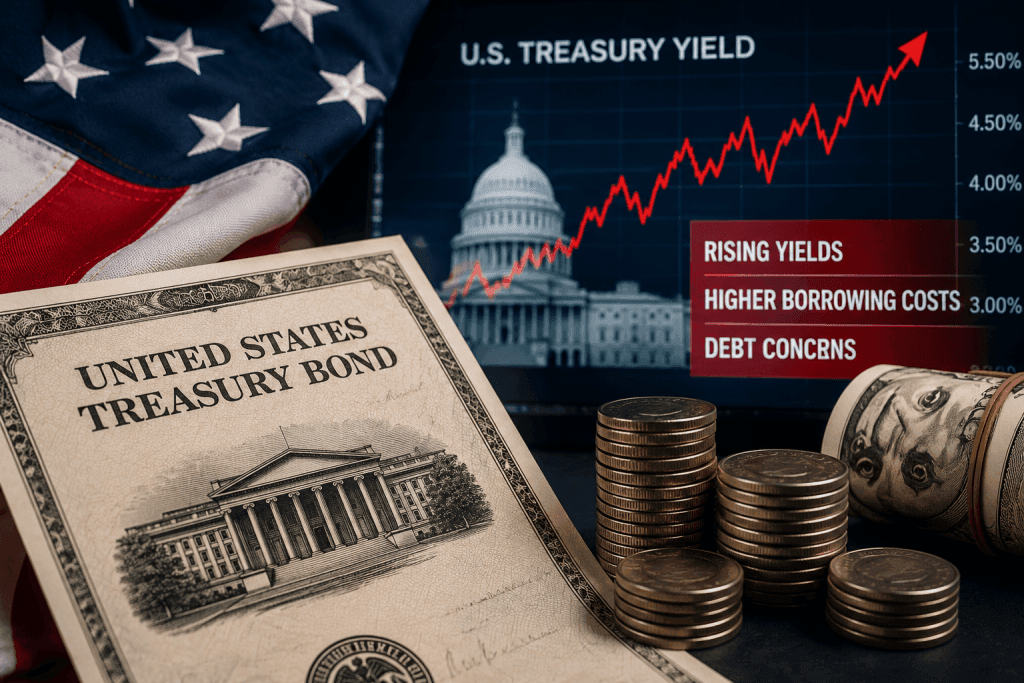
U.S. government bond yields have climbed toward multiyear highs as investors demand greater compensation for inflation, expanding federal borrowing and fiscal uncertainty, raising financing costs across an economy where Treasury rates serve as the benchmark for mortgages, corporate debt and leveraged transactions.
The 30-year Treasury yield reached levels not seen since 2007 during August, while the benchmark 10-year yield approached 4.7%. The move has implications well beyond government finances: sustained increases in risk-free rates can raise the cost of capital for private equity acquisitions, private credit borrowers and companies refinancing existing debt.
The U.S. Treasury’s daily yield curve data showed the 10-year yield at 4.69% and the 30-year yield at 5.23% on Aug. 20. Those levels compared with 4.56% and 5.25%, respectively, on Aug. 10.
The bond-market pressure comes as investors weigh persistent inflation against the growing supply of government securities needed to finance U.S. deficits. Those concerns are increasing scrutiny of whether long-term borrowing costs can decline materially even if monetary policy eventually becomes less restrictive.
Why Treasury Yields Matter Beyond Washington
Treasuries sit at the foundation of global credit markets.
Banks, asset managers and private lenders typically price loans and securities relative to benchmark interest rates. When Treasury yields rise, the cost of financing mortgages, corporate acquisitions, infrastructure projects and other investments can rise alongside them.
The relationship is particularly important for private markets.
Private equity transactions typically combine sponsor equity with substantial debt financing. A higher underlying risk-free rate can increase interest expense, reduce the amount buyers are willing to borrow and pressure the valuation multiples sponsors can justify when acquiring companies.
Private credit faces a more complicated effect.
Higher benchmark rates can increase income on floating-rate loans, supporting returns for direct lenders. But those same rates increase borrowers’ interest burdens, potentially weakening debt-service coverage and increasing restructuring risk.
PE NEWSWIRE previously examined those competing forces in its coverage of Goldman Sachs’ expanding exposure to private credit, where elevated financing returns have been accompanied by questions about underlying borrower risk.
Federal Debt Adds Pressure to the Bond Market
The federal government’s borrowing requirement has become an increasingly important part of the rate outlook.
When Treasury needs to issue larger quantities of debt, investors must absorb additional securities. If demand does not increase at the same pace, yields may need to rise to attract buyers.
That matters because higher yields can create a feedback loop for government finances. As older Treasury securities mature and are refinanced at higher rates, federal interest expense increases, adding further pressure to future budgets.
At the same time, investors are weighing whether inflation will remain sufficiently persistent to keep long-term rates elevated.
The inflation component is critical because investors purchasing a Treasury security for 10 or 30 years need compensation for the risk that future inflation reduces the purchasing power of their fixed payments.
Treasury data showed the 10-year real yield at 2.35% and the 30-year real yield at 2.95% on Aug. 20, indicating that the increase in nominal borrowing costs cannot be attributed solely to inflation expectations.
That suggests investors are also demanding substantial inflation-adjusted returns for holding long-duration government debt.
Consumers Feel Bond-Market Pressure Through Mortgages
For households, one of the clearest transmission channels is housing.
Thirty-year fixed mortgage rates do not mechanically follow the Federal Reserve’s policy rate. They are heavily influenced by longer-term bond yields and the spread investors demand for mortgage-backed securities.
Higher Treasury yields can therefore keep mortgage rates elevated even when investors expect eventual changes in short-term monetary policy.
The same mechanism affects corporate borrowers.
Companies issuing investment-grade or high-yield bonds generally pay a Treasury benchmark plus a credit spread reflecting the additional risk of lending to the business. A higher Treasury rate can consequently increase the all-in cost of new corporate debt even if the company’s own creditworthiness has not deteriorated.
For highly leveraged businesses, relatively small changes in financing costs can materially affect free cash flow.
Private Equity Faces a Higher Return Hurdle
The implications are particularly important for private equity managers seeking to restart dealmaking.
Buyout activity depends partly on the relationship between acquisition valuations, leverage and expected exit returns. Higher borrowing costs make that equation more difficult.
Sponsors can respond by contributing more equity, negotiating lower acquisition prices or targeting companies capable of generating enough earnings growth to offset higher interest expense.
None of those solutions is costless.
Putting more equity into a transaction can reduce potential equity returns, while lower purchase prices require sellers to accept valuations below previous expectations.
Persistent high yields can also complicate exits because prospective buyers face the same financing environment.
The result helps explain why refinancing and liability-management transactions have become increasingly important across private markets while sponsors wait for a more favorable environment for conventional exits.
Private Credit Can Benefit — Until Borrowers Struggle
For private credit investors, elevated rates have been one of the asset class’s strongest fundraising arguments.
Many direct loans carry floating interest rates, meaning lender income increases when benchmark rates rise. That has helped private credit offer attractive yields relative to traditional fixed income.
PE NEWSWIRE has tracked managers expanding access to that opportunity, including Capital Group and KKR’s public-private credit strategy, which combines public fixed-income assets with private lending exposure.
Yet high base rates eventually test borrowers.
Companies originally financed under assumptions of lower interest expense may have less cash available for acquisitions, capital expenditure or distributions when debt costs remain elevated for longer than expected.
That increases the importance of underwriting discipline. Private lenders need to distinguish companies capable of carrying higher interest burdens from borrowers whose capital structures ultimately require amendments, additional equity or restructuring.
Bond Market Could Shape the Next Private-Capital Cycle
The Federal Reserve remains central to short-term interest rates, but the recent Treasury market moves demonstrate that policymakers do not completely control long-term borrowing costs.
Fiscal policy, inflation expectations, economic growth, Treasury supply and global investor demand all influence the yields required by bondholders.
That distinction matters for private markets because a decline in the Fed’s policy rate would not automatically restore the ultralow financing conditions that characterized much of the decade before 2022.
For private equity, persistently higher long-term rates would keep pressure on leveraged-buyout economics and valuations.
For private credit, the environment could preserve attractive yields while simultaneously producing more stressed and restructuring opportunities.
And for institutional investors, government bonds yielding around 5% at the long end create a higher benchmark against which allocations to illiquid alternatives must compete.
The bond market is therefore becoming more than a macroeconomic signal. It is setting the hurdle rate for capital across public and private markets — and could play a decisive role in determining which leveraged investment strategies remain attractive as the next private-capital cycle develops.