UK’s Leading Private Capital Summit Sets AI, Growth and Innovation Agenda for 2035

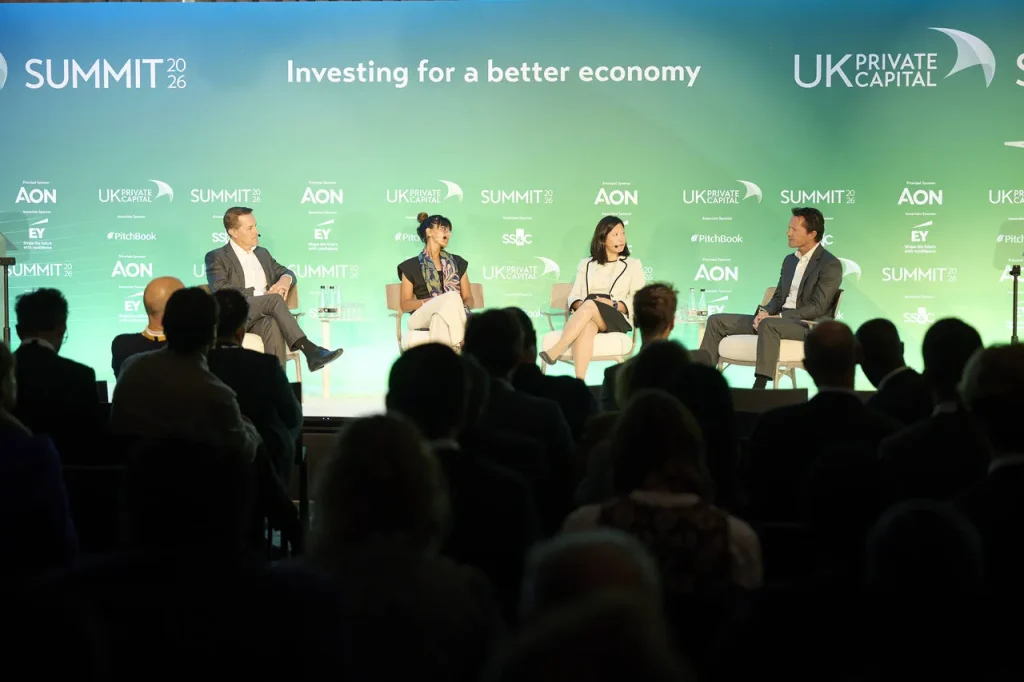
Artificial intelligence, productivity and the commercialization of British research emerged as central investment themes at the UK Private Capital Summit 2026 held on Sept. 10, as private equity, venture capital and private credit leaders assessed how private investment could support economic growth through the next decade.
The Main Conference brought together the wider private capital ecosystem after the Summit opened Sept. 9 with its Pensions Investment and LP-GP events. More than 1,350 attendees, including over 550 general partners and 250 limited partners, were expected across the two-day gathering, according to organizer UK Private Capital.
The discussions put private capital’s role in the UK economy alongside practical questions about AI-driven value creation, institutional investment, competitiveness and the country’s ability to turn publicly funded research into scalable businesses.
Private capital looks toward 2035
The Main Conference opened with a forward-looking discussion involving UK Private Capital Chair Richard Swann, a partner at Inflexion, focused on what success for the UK could look like by 2035 and the importance of sustained engagement among policymakers, investors and businesses.
Political broadcaster Amol Rajan followed with an assessment of the political, media and economic forces likely to shape the coming decade before joining UK Private Capital Chief Executive Michael Moore for a fireside discussion.
The program reflects the wider theme of this year’s UK Private Capital Summit 2026 — “Investing for a better economy.” The association says the private capital industry supports about 13,000 businesses across the UK, giving policy decisions affecting the sector implications beyond fund managers and institutional investors.
The scale of the gathering also illustrates how UK policymakers are increasingly treating private capital as part of the country’s growth and investment infrastructure rather than solely as an alternative asset class.
AI debate shifts from adoption to measurable returns
One of the morning’s most investment-relevant discussions examined whether AI is producing genuine economic value or primarily reducing operating costs.
A panel featuring Apollo Global Management operating adviser Richa Bhuttar, Anthemis Managing Partner Mei Lim and Bain Capital partner Nigel Walder examined how businesses can use AI to increase productivity, lower costs and simplify or consolidate processes.
For private equity, that debate goes directly to value creation.
Managers have historically relied on combinations of revenue growth, operational improvements, leverage and multiple expansion to generate returns. AI potentially adds another lever by automating workflows and improving productivity across portfolio companies, but investors increasingly need to distinguish experimental adoption from technology that produces measurable earnings improvements.
The issue extends beyond buyouts. PE NEWSWIRE previously examined J.P. Morgan’s view of a $3 trillion to $5 trillion AI opportunity increasingly shifting toward private markets as investment moves beyond foundational models and computing infrastructure toward software capable of automating labor-intensive business functions.
The Summit discussion suggests that the next phase for private capital is becoming less about whether portfolio companies should adopt AI and more about how managers quantify its effect on costs, productivity and competitive positioning.
UK growth could move closer to 2%
Former Downing Street adviser Mats Persson, now EY’s UK and Ireland macro and geostrategy leader, used his macroeconomic outlook to examine fiscal policy, energy, AI and productivity.
Persson argued that the UK has the potential to return to economic growth close to 2%, according to the conference account provided to PE NEWSWIRE.
That growth outlook matters for private markets because stronger productivity and economic expansion can improve the environment for portfolio-company revenue, investment and exits. Conversely, weak growth increases pressure on managers to create returns through company-specific operational improvements rather than relying on supportive macroeconomic conditions.
Private capital’s importance to the government’s growth agenda was also evident elsewhere at the conference. Economic Secretary to the Treasury Lucy Rigby told delegates that economic progress depends on ideas receiving financial backing, businesses being built and investment being directed toward opportunity.
In the Treasury’s official Summit address, Rigby framed private investment as part of the government’s effort to connect capital with economic growth.
Commercializing research becomes a capital-allocation challenge
The morning concluded with UK Private Capital policy director Isobel Clarke and UK Research and Innovation Chief Executive Professor Sir Ian Chapman examining how Britain can convert scientific research into commercial returns.
The subject addresses a persistent challenge in the UK investment ecosystem: producing globally significant research does not automatically mean that the companies emerging from that research will scale domestically.
Private capital can intervene at several stages, from early venture financing through growth equity and later-stage institutional investment. The availability of capital at each stage can influence whether companies remain in the UK, sell earlier than intended or seek larger pools of financing overseas.
That makes commercialization relevant not only to venture funds but also to pension investors and larger private-market managers seeking long-duration exposure to technology, life sciences and other innovation-driven sectors.
UK pension capital could become particularly important. PE NEWSWIRE has reported on the UK’s largest pension fund targeting a £1 billion venture capital allocation by 2030, an example of the larger institutional pools policymakers hope can provide more domestic growth capital.
The Summit itself reflects that connection. Its Sept. 9 Pensions Investment Summit specifically examined how private capital could contribute to stronger pension returns and included discussions around AI and technology investment.
Competition for global capital remains central
The discussions also addressed the UK’s ability to remain competitive as an international private-capital center.
Shadow Economic Secretary to the Treasury and Shadow Business Minister Mark Garnier participated in a session focused on maintaining the country’s position as a leading hub for private investment and keeping the economy competitive.
That question encompasses taxation, regulation, capital markets, pension investment and the ability to attract skilled workers and international capital.
UK Private Capital’s Main Conference agenda placed competing for global capital alongside public-private market interaction, national security investment, private credit, productivity and investment across Britain’s nations and regions.
The breadth of those topics shows how the private-markets policy discussion has expanded. Fundraising and dealmaking remain central to the industry, but managers increasingly operate within debates about pension reform, technology policy, national infrastructure and economic competitiveness.
From AI spending to AI productivity
For investors, one of the clearest messages from the morning sessions is that AI is moving into a different phase of the private-capital investment cycle.
Large pools of capital have already been committed to computing capacity, data centers, semiconductor infrastructure and AI developers. The next question is whether those investments translate into sustained productivity gains across the wider economy.
Private equity managers face that question inside existing portfolio companies. Venture investors face it when determining which AI businesses can develop durable economics. Institutional investors face it when deciding how much long-term capital to allocate to the infrastructure and companies supporting the technology.
Commercializing UK research creates a related challenge: ensuring promising technologies can obtain sufficient capital to develop into businesses capable of generating institutional-scale returns.
The Summit’s focus on 2035 therefore extends beyond forecasting the size of the private capital industry. It asks whether Britain can connect research, technology, institutional savings and private investment efficiently enough to generate stronger economic growth.
For private-market investors, success will ultimately be measured less by the amount of capital committed to AI or innovation than by whether that capital produces scalable companies, stronger portfolio earnings and realizable investment returns.